Etosha National Park
Namibia's wildlife theater around a vast ancient salt pan
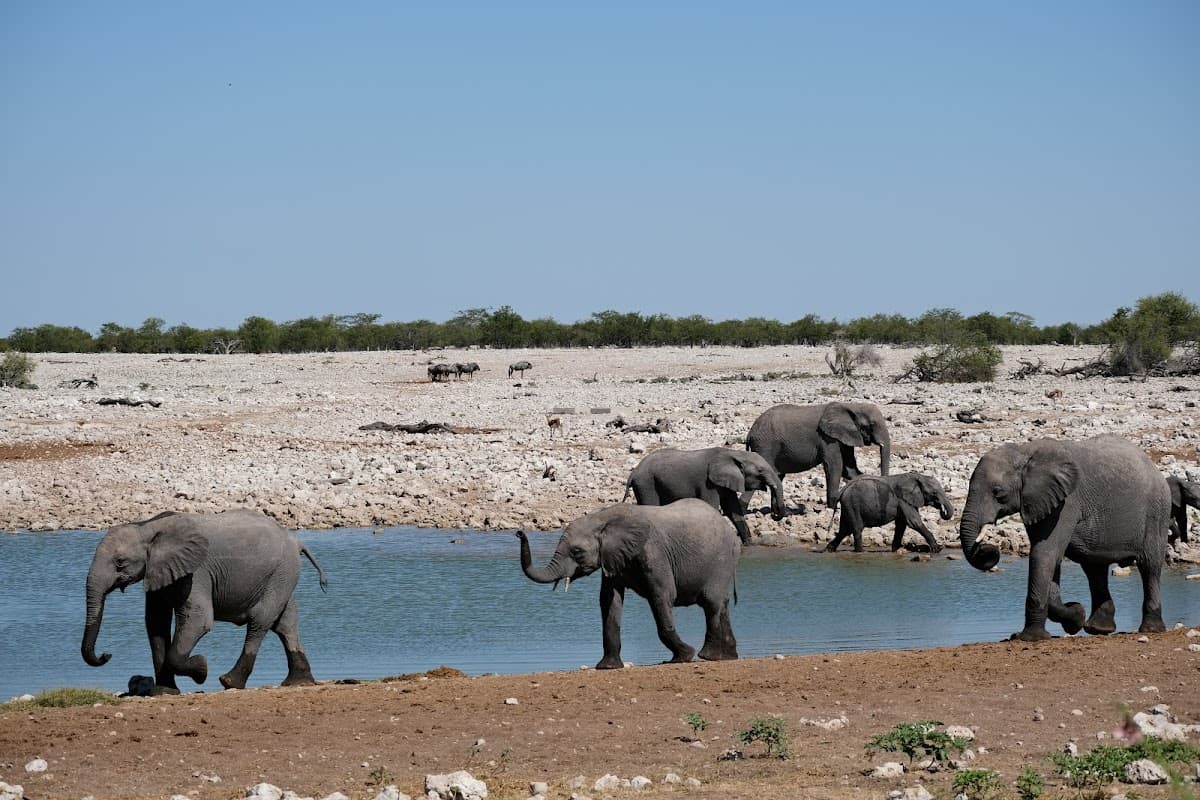
Picture this: a bone-white salt pan stretching to the horizon, dotted with elephants, zebras, and lions gathering at scattered waterholes. That's Etosha National Park, where Namibia's ancient Kalahari Desert meets one of Africa's most spectacular wildlife theaters. The park wraps around the massive Etosha Pan — a 4,800-square-kilometer salt flat that shimmers like a mirage and transforms into a shallow lake during rare rainy seasons. But here's what makes Etosha special: the animals come to you. Permanent waterholes along the southern edge of the pan create natural viewing amphitheaters where you can watch the drama of the African savanna unfold from your car or camp chair.
Culture & Context
Etosha sits in northern Namibia, close to Ovamboland — home of the Ovambo people, Namibia's largest ethnic group and the cultural heartland of the region.
The park itself was established in 1907 during German colonial rule, and that layered history is visible everywhere: the Namutoni fort in the east is a German colonial outpost turned museum. The Himba people, known for their distinctive red ochre skin and hair, live in the Kunene region to the northwest and occasionally interact with park visitors near the western Galton Gate area.
Namibia is broadly Christian but indigenous belief systems remain strong, particularly among Ovambo and Himba communities. The country only gained independence from South Africa in 1990, and topics like colonial history and land ownership carry real weight — tread respectfully. Greetings matter enormously here.
In rural northern Namibia especially, a proper greeting before any conversation is not optional — it's basic respect. The country speaks English officially, but Oshiwambo dominates in the north, and Afrikaans fills in the gaps everywhere else. Expect a warm, unhurried pace.
Don't rush locals. The Etosha area is not a hiker's park — you spend most of your time in or near a vehicle, which suits the terrain. The landscape is stark, almost lunar, dominated by the white Etosha Pan.
That pan — 5,000 square kilometers of flat salt — is visible from space and defines everything: where the animals go, where the waterholes sit, what the light does at golden hour.
Local Customs
Greet first, always.
In northern Namibia, launching into a request without a proper greeting is considered rude. Say hello, ask how someone is, and give it a moment before getting to business..
Handshakes are the standard greeting. Hold your right elbow with your left hand while shaking — this signals extra respect, especially with elders.. Among Ovambo people (dominant group near Etosha), clapping hands while greeting is common.
Follow the lead of whoever you're meeting.. Always ask permission before photographing people, especially Himba community members. Some expect a small donation in return — have small NAD notes ready..
Do not point with your index finger. Use your whole hand or thumb instead.. Plastic bags are completely banned inside Etosha National Park.
Bring reusable bags.. Drones are strictly prohibited inside the park. Declare any drone at the gate — it will be held in storage until you leave.
No exceptions.. Stay in your vehicle at all times except at designated rest camps and fenced viewpoints. This rule is about safety, not bureaucracy — lions and elephants are genuine hazards outside your vehicle..
Do not feed wildlife under any circumstances. It disrupts animal behavior and can result in ejection from the park.. Tipping 10–15% at restaurants is expected if service is good.
Guides and camp staff appreciate cash tips in small NAD or ZAR notes.. Braai (BBQ) culture is central to Namibian social life. If invited to one, bring drinks or snacks — it's the done thing..
Avoid political conversations about colonial history and land ownership with strangers — these are sensitive topics.
Safety
Etosha is genuinely one of Africa's safer safari destinations.
No malaria during the dry season (May–October) — the park is effectively malaria-free in those months. During the wet season (November–April), a slight risk exists near pan margins; consult a travel health specialist and consider prophylaxis.
Crime inside the park is extremely low. The main risks are wildlife-related and entirely preventable. The golden rule: stay inside your vehicle except at designated fenced rest points and camps.
Elephants and rhinos can charge — do not approach, do not drive between herds, and do not exit your vehicle for a photo opportunity. If wildlife blocks the road, switch off the engine, avoid sudden movements, and give animals all the time they need. Speed limit is 60 km/h on gravel roads and strictly enforced — for wildlife safety as much as yours.
Night driving outside camps is prohibited. Plan to be back at your camp before sunset. Carry ample water — daytime highs reach 30–33°C, and the heat is deceptively intense.
Apply high-SPF sunscreen and wear a wide-brimmed hat. Keep fuel topped up at every opportunity; the three in-park fuel stations (Okaukuejo, Halali, Namutoni) can run out. Mobile signal is unreliable — download offline maps and carry a physical park map.
Drones are completely banned — declare any drone at the gate or face confiscation. Plastic bags are banned inside the park. For the US Embassy advisory: exercise normal caution in Namibia.
Non-violent opportunistic crime (pickpocketing, smash-and-grabs) exists in Windhoek and other towns but is rare inside the park itself.
Getting Around
Getting to Etosha: Fly into Hosea Kutako International Airport in Windhoek, then drive roughly 400–430 km north (5–6 hours) via the B1 highway to Anderson Gate in the south.
It's the main entry point from Windhoek and the most common route. Alternatively, fly into Ondangwa Airport (closer to the northern King Nehale Gate) for travelers coming from the Ovamboland side.
Inside the park: Self-driving is the dominant mode and Etosha is one of Africa's best self-drive parks. Well-maintained graded gravel roads connect all camps and major waterholes. A standard 2WD vehicle handles the main routes comfortably in dry season (May–October).
A 4WD is recommended for the rainy season or if you plan to combine Etosha with Damaraland or Kaokoland. The speed limit is 60 km/h on gravel and strictly enforced. No driving after dark inside the park — all visitors must be at their camp by sunset.
Gates: Anderson Gate (south, main access from Windhoek), Von Lindequist Gate (east, via Tsumeb — 5 minutes from Namutoni), King Nehale Gate (north-east), Galton Gate (west, remote, permit required for western sections). Gate hours: sunrise to sunset, varying by season. Guided safaris: Night drives depart from inside the camps after gate closing — they are authorized to operate after hours and do not require re-entry.
Guided day drives are also available from each NWR camp. Fuel available only at Okaukuejo, Halali, and Namutoni — top up constantly as stock runs out. No shuttle or public transport operates inside the park.
Useful Phrases
Money-Saving Tips
- 1.Book accommodation packages that include park entry fees to save on daily permits
- 2.Stock up on food and supplies in Outjo or Tsumeb before entering — camp shops charge tourist prices
- 3.Camping at rest camps costs fraction of lodge prices while keeping you inside the park for night game viewing
- 4.Self-drive safaris cost far less than guided tours and give you flexibility to spend time at productive waterholes
- 5.Fuel up outside the park — petrol stations at camps charge premium rates
- 6.Visit during shoulder season (May-June) for lower accommodation rates and fewer crowds
Travel Tips
- •Download offline maps before entering — cell service is spotty throughout most of the park
- •Arrive at waterholes early morning or late afternoon when animals are most active
- •Keep your distance from elephants — they're unpredictable and have right of way on all roads
- •Bring red-filtered headlamp for night waterhole viewing — white light scares animals away
- •Pack extra water and snacks — distances between facilities are vast and breakdowns happen
- •Check road conditions before heading to remote waterholes — some require high clearance vehicles
- •Respect park rules about staying in vehicles — lions and leopards patrol these roads regularly
Frequently Asked Questions
BUILD YOUR
ETOSHA NATIONAL PARK PLAN
Insider picks, smart timing, and a plan ready when you are.
Start Planning