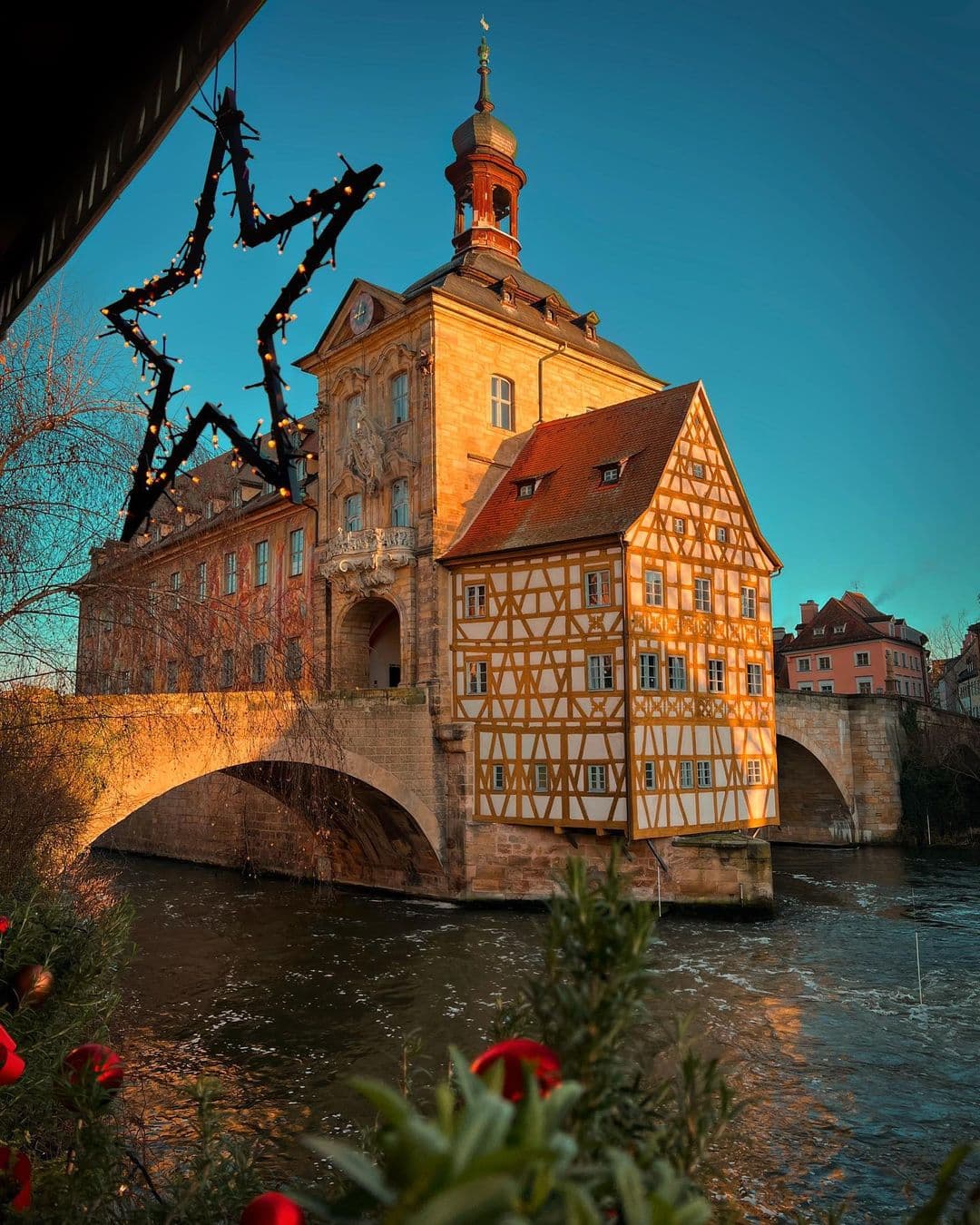
Bamberg
Medieval UNESCO town famous for smoked beer tradition
Bamberg feels like someone pressed pause on the Middle Ages. This Franconian town survived World War II completely intact, leaving you with 1,000 years of architecture spread across seven hills. The Altstadt is a UNESCO World Heritage site for good reason — half-timbered houses lean over cobblestone streets, and the cathedral towers above it all like something from a fairy tale.
But here's what makes Bamberg special: it's not just a museum. People actually live here. Students from the university fill the beer gardens, locals shop at the weekly market on Maxplatz, and nine breweries still operate within the city limits. You'll taste Rauchbier — smoked beer that's been brewed here for centuries and tastes like liquid campfire.
The Regnitz River splits the town into distinct quarters. Little Venice (Klein Venedig) showcases colorful fishermen's houses right on the water. The cathedral district holds the religious power. And the old merchant quarter buzzes with restaurants and shops. You can walk the entire historic center in 20 minutes, but you'll want to linger much longer.
Best Months
MAY – SEP
~22°C · high crowds
Culture & Context
FRANCONIAN PRIDE, NOT BAVARIAN
Bamberg sits in Upper Franconia, and that distinction matters more than you'd think. Call someone here "Bavarian" and watch them correct you. Franconians have their own dialect, their own flag (red and white, not the blue-and-white checkerboard), and a very specific pride in their beer culture.
The city has been a UNESCO World Heritage Site since 1993, and with good reason: it survived World War II bombing largely intact, meaning the Altstadt is genuinely medieval, not a postwar reconstruction. Built across seven hills, locals jokingly call it "Franconian Rome" — though Rome doesn't have smoked beer or pork knuckle, so the comparison only goes so far. The Bamberg Symphony Orchestra is world-class and performs September through May at the Konzerthalle.
There are 13 local breweries within city limits, and 60 more in the surrounding region, producing around 400 different beers. The Rauchbier (smoked beer) is the famous one — made with malt dried over open fire. It smells like a smokehouse and tastes like one too.
Some people love it immediately. Others need three tries. But the Kellerbier and Ungespundetes are quietly excellent alternatives that don't get the tourist spotlight.
And here's something worth knowing: the expression "on the cellar" (auf dem Keller) refers to the hillside beer gardens built over actual underground tunnels once used for fermentation. It's not metaphorical. The Gärtnerstadt (Gardeners' Quarter) is genuinely unique — medieval market gardens still actively cultivated inside the city, growing the famous Bamberger Hörnla potato and other local crops.
Nowhere else in Europe does this.
Local Customs
CASH, CORRECTIONS & BEER GARDENS
Franconians will correct you if you call them Bavarian. Don't. They have their own anthem (the Frankenlied), their own flag, and a cultural identity that's been distinct for centuries.
Acknowledge it and you'll be welcomed warmly.. Drinking beer in the street or on bridges is completely normal and socially accepted — especially during festivals. The bridges fill up by early afternoon during the Sandkerwa..
Many smaller breweries, bakeries, and cafes are cash-only. This is not a quirk to be fixed; it's intentional. Always carry euros..
Shops close on Sundays by law. Stock up on Saturday. Restaurants and beer gardens stay open, but don't plan supermarket runs..
Tipping is done in cash, not by card. Round up or add around 10%. Simply say the total you want to pay when the server comes to collect — saying 'stimmt so' (it's fine, keep the change) is the local way..
The Schlenkerla brewery at Dominikanerstraße 6 is the most famous spot for Rauchbier — it's been serving since 1405, and the smoked beer is tapped directly from wooden barrels. But fair warning: service can be brusque, and if you're not ordering food, you may be asked to drink outside. It's a feature, not a bug.
The brewery earns its reputation on the beer, not the hospitality.. Locals use the hill-top beer gardens ('Keller') extensively in summer. The Spezial-Keller has city views and Sunday jazz brunches.
Get there early — seating goes fast on warm evenings.. The Bamberger Hörnla potato is a local delicacy. If it appears on a menu, order it.
It's not exported or widely available outside the region.
Safety
VERY SAFE, FESTIVAL-CROWDED STREETS
Bamberg is a very safe city. Violent crime is rare, and the local authorities are responsive. Standard European city precautions apply — watch your bags in crowded festival areas, particularly during the Sandkerwa when the Sandstraße fills to an uncomfortable density.
The organizers have 60+ years of experience running the festival, and it remains orderly despite the crowds. One genuine note: the narrow medieval streets during peak Sandkerwa evenings are not easy to exit quickly if you need to. Know your nearest route out to a wider street before you're deep in the crowd.
For everyone else visiting outside festival time, the city is relaxed and low-stress to navigate.
Getting Around
WALKABLE & RAIL-CONNECTED
Bamberg is on the main Frankfurt-Munich and Würzburg-Hof rail lines, with trains running at least hourly in most directions. The nearest major airport is Nuremberg (NUE), about 45 minutes by car or an hour by train and subway. Frankfurt Airport connects directly by train to Frankfurt Hauptbahnhof, from which there are fast rail connections.
Locally, the city runs a bus network, but honestly Bamberg is compact and extremely walkable. Most visitors see the entire old town on foot. A single bus ticket costs around €2.
70. If you're spending more than a day or two and plan regional excursions, the Deutschland-Ticket at €63/month covers all regional buses and trains across Germany — outstanding value for getting out to the surrounding Franconian countryside, Nuremberg, or Würzburg. Cycling is popular and the terrain is flat enough in the river valley parts of town.
The hills (Michaelsberg, Domberg) require some effort on foot. Carry cash for bus tickets where card readers may not be available on older vehicles.
Useful Phrases
Money-Saving Tips
- 1.Buy beer directly from breweries instead of restaurants — a half-liter costs €2.50 at the source versus €4.50 in tourist areas
- 2.The Bamberg Card (€12) includes public transport and discounts at museums, but most attractions are free to explore from outside
- 3.Shop at REWE or Edeka supermarkets in the Gärtnerstadt district — prices are 20-30% lower than convenience stores in the Altstadt
- 4.Many beer gardens let you bring your own food if you buy drinks — grab supplies from the Saturday market on Maxplatz
- 5.Free brewery tours happen at Schlenkerla on Saturdays at 2 PM — just show up, no reservation needed
- 6.Parking meters don't run on Sundays or after 6 PM weekdays — time your arrival to save €10-15 daily
- 7.The regional day pass (€24) covers trains to Würzburg, Nuremberg, and surrounding villages — better value than individual tickets
Travel Tips
- •Cobblestones get slippery when wet — pack shoes with good grip, especially in winter
- •Learn to say 'Ein Rauchbier, bitte' (one smoked beer, please) — locals appreciate the effort
- •The cathedral closes during services — check the schedule if you want to see the interior
- •Many restaurants close between 2-5 PM — plan lunch accordingly or pack snacks
- •Bamberg's breweries use different glass sizes — ask for a 'halbe' (half-liter) to compare prices fairly
- •The Little Venice area floods during heavy rains — wear waterproof shoes if storms are forecast
- •Book restaurant reservations for Friday and Saturday nights — popular spots fill up quickly
- •Carry cash — many traditional establishments don't accept cards, especially smaller beer halls