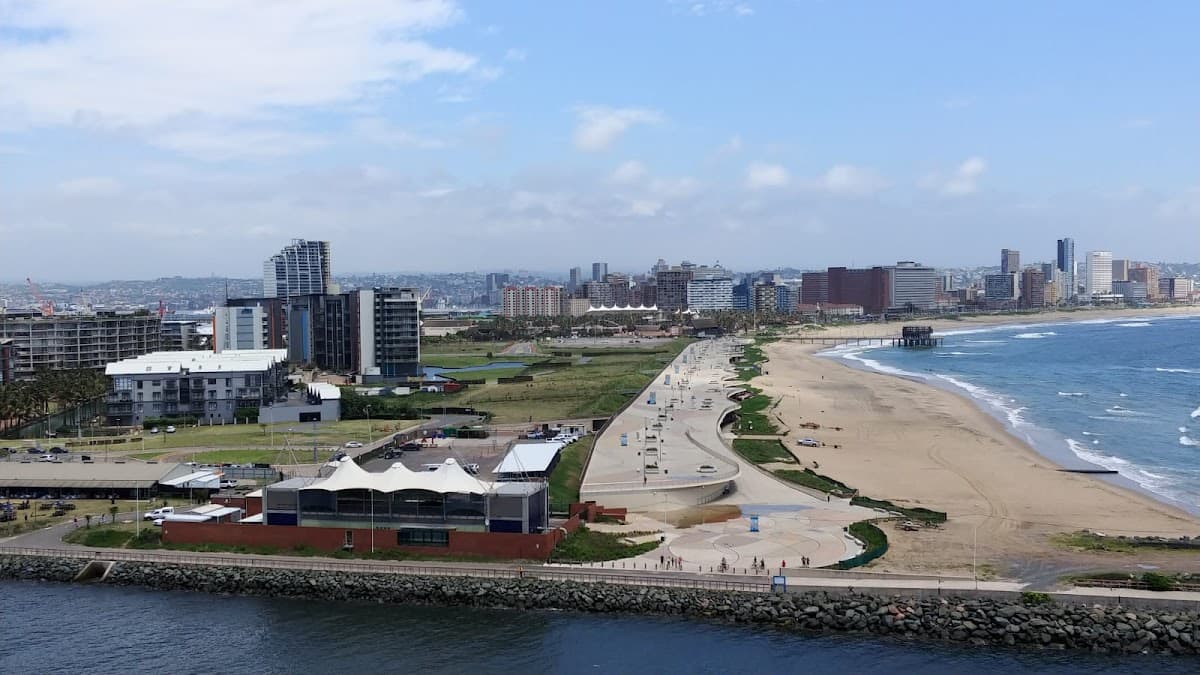
Durban
South Africa's vibrant beachfront melting pot
Durban hits different. This isn't your typical South African city break — it's where Indian spice markets meet Zulu culture on a backdrop of year-round sunshine and some of the country's best beaches. The Golden Mile stretches for six kilometers of prime real estate, but the real magic happens in the neighborhoods behind it. Chatsworth serves up the best bunny chow you'll find anywhere. The Berea offers Art Deco architecture and harbor views. And uShaka Marine World keeps the kids happy while parents sip cocktails at beachfront bars. Look, Durban gets overlooked for Cape Town and Jo'burg, but that's exactly why it works. Fewer crowds, better value, and a food scene that'll ruin you for Indian cuisine anywhere else.
Best Months
APR – SEP
~22°C · low crowds
Culture & Context
INDIA MEETS ZULU HEARTLAND
Durban carries the largest Indian population outside of India — a legacy of the 1860s indentured labour system when workers were brought from British India to work sugar cane plantations. That history shows up everywhere: in the food, the architecture of the Victoria Street Market, the mosques and temples dotting the city, and the distinctly Durban accent that blends Zulu, Afrikaans, English, and Indian languages into something you genuinely won't hear anywhere else. The city sits in KwaZulu-Natal, Zulu heartland, and that influence is just as present.
Locals are generally warm and direct. The pace of life is slower than Johannesburg. People talk about "Durban time" the same way Australians talk about "island time" — nothing starts exactly when it says it will.
Durban hosted Africa's Travel Indaba in May 2026, reaffirming its position as the continent's third-largest city and primary port. The Zulu name for Durban is eThekwini, meaning "bay" or "lagoon," and you'll see it used on signage and in official contexts throughout the city.
Local Customs
TIP CAR GUARDS, GREET FIRST
Tipping car guards is expected — R5-10 is standard. These are informal workers who watch your parked car. Don't skip it..
The braai (BBQ) is serious business. If a local invites you to a braai, bring your own drinks and something to share — showing up empty-handed is a faux pas.. Greet people before launching into any request.
Starting a conversation at a shop or market without a 'howzit' first reads as rude.. Tipping at restaurants is expected: 10-15% is standard, 20% for good service.. Check beach conditions before swimming — some beaches have had E.
coli contamination issues. Stick to monitored swimming areas with lifeguards and shark nets.. Dress modestly if visiting mosques or temples in the Victoria Street Market area.
The Indian Quarter has active places of worship.. Don't get into unmarked taxis or accept rides from strangers at the airport. Use Uber or pre-booked transfers..
Visiting townships is genuinely worthwhile, but go with an accredited local guide — not independently and not on someone's casual offer outside a tourist site.. Electricity runs on 220/230V with Type M (large 3-pin) plugs. Bring an adapter..
Malaria risk exists in parts of KwaZulu-Natal, especially if heading north toward Hluhluwe. Check with your doctor about prophylaxis before traveling.
Safety
STAY AWARE AFTER DARK
Durban carries a medium risk level. Most serious crime is concentrated in specific areas and rarely involves tourists who stay aware. Here's the honest picture.
The Golden Mile beachfront during daylight hours is well-patrolled and generally safe — families and joggers are out in numbers. uShaka Marine World and Moses Mabhida Stadium have strong security. At night, the calculation changes.
Do not walk alone after dark, even in safer areas like Morningside, unless you're moving between well-lit, well-known spots. Use Uber instead of minibus taxis — minibuses are crowded and occasionally unsafe for tourists unfamiliar with the routes. Fake police officers are a known scam — if stopped by someone claiming to be a plain-clothes officer, do not hand over your passport or wallet.
Ask to be taken to a police station. At ATMs, use machines inside shopping centres rather than street-facing ones. Keep your phone out of sight in the CBD and at busy street markets.
The Victoria Street Market area is fine during the day; avoid it after dark. Scammers sometimes pose as shop workers offering 'discounts' — if someone approaches you with an unsolicited deal, walk away. The beach itself has a genuine E.
coli contamination history at certain spots — check current conditions before swimming and stick to the designated swimming areas with lifeguards. For road trips, avoid driving at night on rural roads. Emergency numbers: Police 10111, Ambulance 10177, or call 112 from any mobile.
Getting Around
UBER & RENTAL WHEELS
King Shaka International Airport sits about 35km north of the city centre. An official airport shuttle runs around R80. A metered taxi will cost R400+.
Uber is the best option for getting around once you're in the city — affordable, reliable, and trackable. Download the app before you land. A 20-minute cross-city Uber typically runs R100-150.
The People Mover tourist bus connects the CBD to the beachfront and several popular locations — useful for the Golden Mile area. Minibus taxis are the primary transport for locals but are crowded, follow informal routes, and are not recommended for first-time visitors. Renting a car is the best call if you want to explore beyond the city — Hluhluwe Game Reserve, the Valley of a Thousand Hills, and the South Coast all require wheels.
Stick to major highways (N2 and N3) and avoid rural roads after dark. Drive on the left. Fuel is readily available.
Inter-city buses from Greyhound, Intercape, and Translux connect Durban to Johannesburg (roughly 6 hours), Cape Town, and destinations in Mozambique. The BazBus hop-on-hop-off service is popular with backpackers. Street parking along Florida Road is generally free but always tip the car guard R5-10.
Useful Phrases
Money-Saving Tips
- 1.Bunny chow costs R25-40 at local spots vs R80+ at tourist restaurants
- 2.Beach parking is free on weekdays before 9 AM and after 5 PM
- 3.Buy spices at Warwick Junction markets — prices are 70% less than supermarkets
- 4.Many museums offer free entry on certain weekdays — check individual websites
- 5.Uber Pool can cut transport costs by 30-40% if you're not in a rush
- 6.Happy hour at beachfront bars runs 4-6 PM with half-price cocktails
- 7.Street food at the markets costs R15-25 per portion vs R150+ at restaurants
- 8.Municipal beaches have free parking on Sundays
- 9.Local taxis (minibus) cost R8-12 vs R50+ for Uber on popular routes
Travel Tips
- •Download the Uber app before arrival — it's safer and more reliable than street taxis
- •Carry cash for markets and street food — many vendors don't accept cards
- •Book Indian restaurants in advance on weekends — the good ones fill up fast
- •Don't walk alone after dark, especially between neighborhoods
- •The ocean has strong currents — swim between the lifeguard flags
- •Tipping is expected — 10-15% at restaurants, R20-30 for hotel staff
- •Learn basic Zulu greetings — locals appreciate the effort
- •Sunscreen is essential year-round — the African sun is intense even in winter
- •Keep copies of your passport — some venues require ID for entry
- •The weather can change quickly — pack layers even in summer