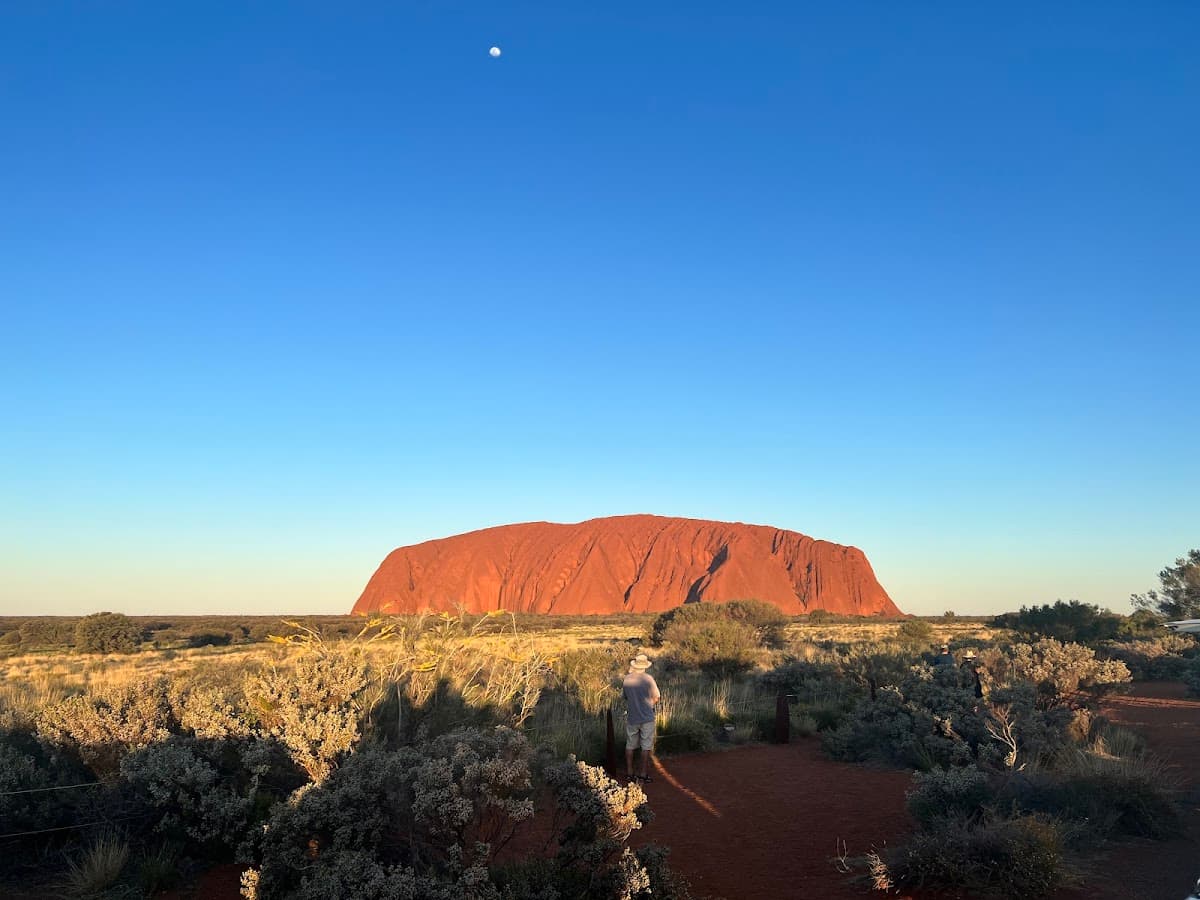
Uluru
Australia's Sacred Heart and Spiritual Center
Uluru isn't just a rock. It's the beating heart of Australia, a sacred monolith that's been drawing pilgrims and wanderers for 60,000 years. Here in the Red Centre, 450 kilometers southwest of Alice Springs, this sandstone giant rises 348 meters from the desert floor like something from another world.
The Anangu people, traditional owners of this land, call it the most sacred site in Australia. And once you see how it glows at sunrise, shifting from deep purple to fiery red to golden yellow, you'll understand why. This isn't just another tourist destination - it's a place that changes you.
But here's what most visitors don't expect: Uluru is just one part of a much larger story. The surrounding Uluru-Kata Tjuta National Park covers 1,326 square kilometers of desert landscape, dotted with sacred sites, walking trails, and cultural experiences that connect you to the world's oldest continuous culture. The nearby Kata Tjuta (The Olgas) offers equally stunning formations, while the town of Yulara provides all the amenities you need without disturbing the sacred sites.
Best Months
APR – SEP
Culture & Context
SACRED COUNTRY, NOT BACKDROP
Uluru is a 348-metre sandstone monolith rising from an otherwise flat desert in Australia's Red Centre, about 450 kilometres from Alice Springs. It's been here for roughly 600 million years, and the Anangu people (pronounced "arn-ung-oo") have lived alongside it for at least 10,000 of those. This is their Country, not a tourist backdrop.
The rock holds deep spiritual significance through the Tjukurpa, the Anangu system of law, knowledge, and stories that governs how the land is understood and cared for. Climbing has been permanently banned since October 2019, and that scar of a white trail you can still see on the rock is a reminder of what took too long to stop. The resort town of Yulara, about 18 kilometres from the rock, is the only place to stay.
Everything, from the five-star hotels to the campground, is operated by one company: Voyages Indigenous Tourism Australia. That monopoly shapes the whole experience, for better and worse. Prices are high.
But the Anangu stories and art you access here are genuine, and the guided cultural experiences are worth every dollar.
Local Customs
DON'T CLIMB ULURU
Don't climb Uluru. Full stop. The ban has been in effect since October 2019.
The Anangu have asked visitors not to climb for decades before that. The white scar still visible on the rock is called the 'scar of Uluru'. There is no debate here..
Photography is restricted at certain sacred sites around the base walk. Mala Puta and Pulari are two sites specifically tied to women's cultural business. Signage is clear at the rock.
When in doubt, put the camera down.. Never photograph an Anangu person without asking their permission first. This is serious – people have been asked to delete photos on the spot..
The park is mostly alcohol-free. Drinking is only permitted at the Uluru Car Sunset and Uluru Bus Sunset viewing areas, and by licensed commercial tour operators with direct written approval from park management. Do not walk through the park with a beer..
Swimming in any waterhole inside the national park is not permitted. The resort pools exist for a reason.. Drones are banned in the national park.
Operating one without a permit is an offence under the EPBC Act. Penalties apply.. Use the name Uluru, not Ayers Rock.
The park officially uses Uluru/Ayers Rock, but the Traditional Owners have always called it Uluru. Calling it Ayers Rock at the cultural centre is a bit like calling Istanbul Constantinople to a local.. The park sometimes closes with very little notice for 'Sorry Business' – funeral and mourning ceremonies following the passing of community members.
This is culturally important and non-negotiable. Check the park website before your visit. The park closed on June 25–26, 2026, for exactly this reason..
Bring cash. Card machines at roadhouses occasionally fail, and Anangu artists selling work at the sunset viewing area and around the resort prefer cash transactions.
Safety
DESERT HEAT, UNFORGIVING
The desert here is not forgiving. Summer (December to February) means temperatures regularly exceeding 40°C, and certain walking tracks close automatically when heat thresholds are reached – respect those closures. Heat-related medical emergencies happen every year.
If you're visiting May to September (the smart window), days are 15–25°C and manageable, but winter nights can drop below zero – that's not a typo. Layer up for any sunrise viewing. Carry at least 1 litre of water per person at all times on walks, more if you're doing the full 10.
6km base walk. Snake encounters are possible on bush tracks. Remain calm, do not try to touch them, and move away slowly.
Phone reception around the park is patchy; better at the resort and resort township. There is no taxi service and no public transport. If you're self-driving and break down on the road from Alice Springs (450km, mostly desert), you'll want to have told someone your itinerary.
The medical centre at Yulara Resort handles most visitor emergencies. For serious incidents, evacuation to Alice Springs is the route.
Getting Around
FLY IN, HIRE CAR
Flying in is the easiest option. Ayers Rock Airport (AYQ) accepts direct flights from Sydney, Melbourne, and Cairns (roughly 3 hours). Book a window seat on the left side flying in for a view of the rock on approach.
No public taxi service exists at Uluru. Once at the resort, a free shuttle bus loops around all hotels, the campground, the town square, Gallery of Central Australia, and the camel farm every 20 minutes from 10:30am to 12:30am. It does not go into the national park itself.
For getting around the park, you have two real options. Hire a car (pick up at AYQ airport and go at your own pace) or buy the Hop-on Hop-off Bus 3-day pass ($230 AUD per adult, $115 per child, from April 2026). The hop-on bus covers Uluru viewing spots and includes two transfers to Kata Tjuta.
Note: your national park pass ($38 AUD per adult) is separate and must be purchased before boarding. Buying it online in advance saves queuing at the entry station. If driving from Alice Springs, it's 450km down a fully sealed road – doable in about 4.
5–5 hours in a standard 2WD vehicle. A 4WD is only necessary if you're approaching from Western Australia.
Useful Phrases
Money-Saving Tips
- 1.Book accommodation 6+ months ahead for April-September to avoid premium last-minute rates
- 2.Bring duty-free alcohol - resort bars charge $9+ for beer, $12+ for wine
- 3.Shop at Yulara IGA for self-catering supplies rather than eating all meals at resort restaurants
- 4.The free shuttle bus covers major attractions, but renting a car gives you flexibility for sunrise/sunset visits
- 5.Pack layers for winter nights - temperatures drop to 5°C despite warm days
- 6.Buy the Uluru-Kata Tjuta National Park three-day pass ($38) rather than single-day entries
- 7.Outback Pioneer BBQ & Bar lets you cook your own steak for less than restaurant prices
- 8.Consider camping at Ayers Rock Campground ($55/night) versus hotel rates of $280-600
- 9.Book cultural tours through Anangu Tours for authentic experiences at reasonable prices
- 10.Summer visits (Dec-Feb) offer 50% cheaper accommodation but extreme heat limits activities
Travel Tips
- •Respect the climbing ban - Uluru is sacred to the Anangu people and climbing has been prohibited since 2019
- •Carry more water than you think you need - the dry desert air dehydrates you quickly
- •Download offline maps before arriving - cell coverage can be spotty outside Yulara
- •Book the Sounds of Silence dinner for clear nights only - cloudy skies ruin the stargazing experience
- •Start the Uluru base walk early morning or late afternoon to avoid midday heat and crowds
- •Bring a good camera with telephoto lens - you can't get close to Uluru's base in many areas
- •Pack warm clothes for winter nights even though days are pleasant
- •Learn basic Anangu cultural protocols before visiting sacred sites
- •The Cultural Centre provides essential context - visit before exploring Uluru itself
- •Fly spray and sunscreen are essential year-round in this desert environment