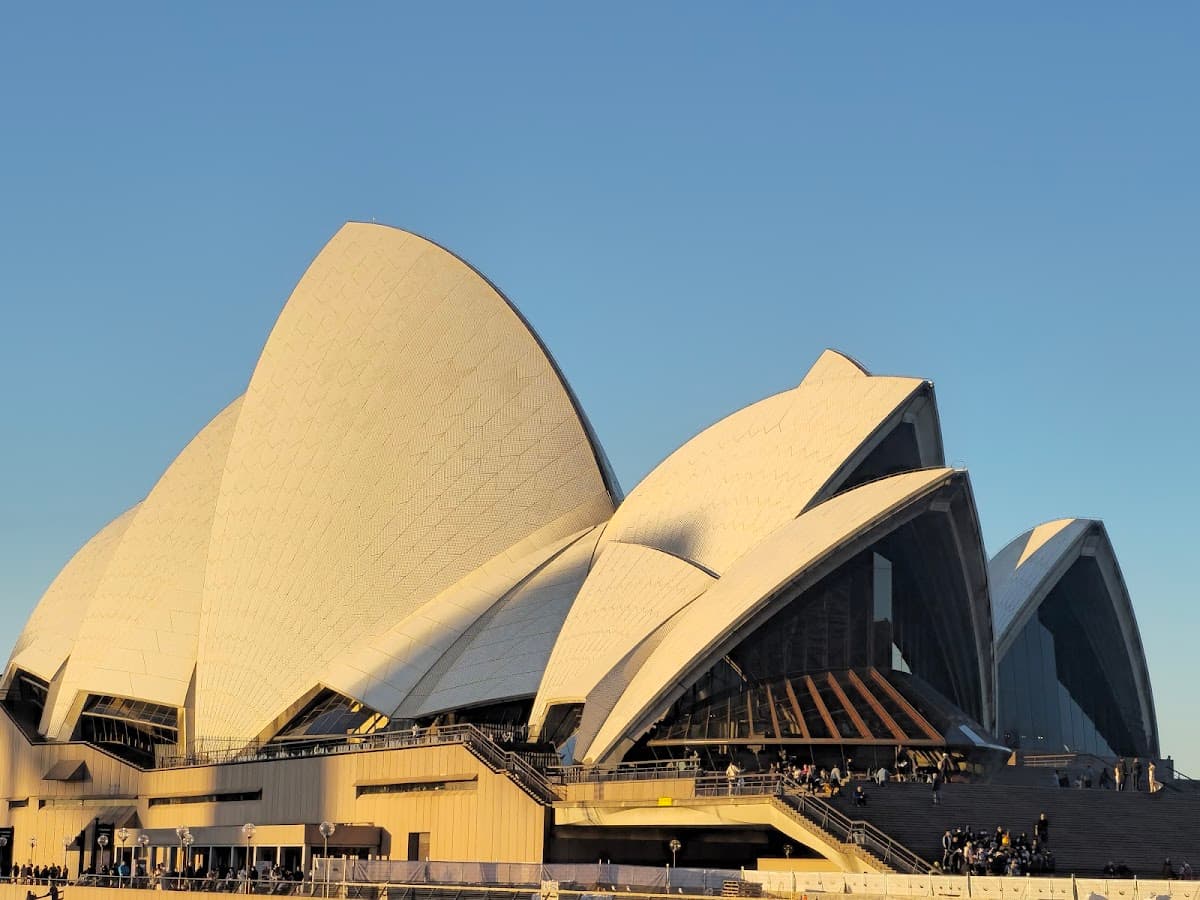
Sydney Opera House
Architectural icon sails majestically above Sydney Harbour
Those white concrete shells rising from Sydney Harbour aren't just pretty to look at — they're home to some of the world's best performances. The Sydney Opera House draws millions of visitors each year, and for good reason. You can catch everything from opera to comedy shows inside, or simply admire the architecture from Circular Quay. But here's what most tourists miss: the best views aren't from the front steps. Head to Mrs Macquaries Chair at sunrise, or grab a harbor cruise ticket for $45 to see those famous sails from the water. The building looks completely different depending on where you stand.
Culture & Context
The Sydney Opera House sits on Gadigal Country — specifically Tubowgule, Bennelong Point.
It's named after Bennelong, a Gadigal man who was significant in early colonial history and whose complex story of mediation between Aboriginal people and the British First Fleet is deeply embedded in this site. The Opera House acknowledges this formally at every event. It's worth knowing, not just as a formality.
The building itself is a story of architectural genius and political disaster. Danish architect Jørn Utzon won the 1956 international design competition as an unknown, with a radical design of interlocking shell-shaped roofs unlike anything ever built. Construction started in 1959 and became a saga of cost overruns, engineering problems, and bitter politics. Utzon resigned in 1966 — he never saw the finished building, and reportedly never returned to Australia. The NSW government finished it under architect Peter Hall. Queen Elizabeth II opened it on 20 October 1973, at a final cost of AU$102 million against an original estimate of AU$7 million. In 2007, it became a UNESCO World Heritage Site — one of the youngest buildings ever to receive the honour.
Today it hosts over 2,000 performances a year across seven venues, attended by around 1.5 million ticket-holders. Another 11 million people walk the public concourse annually. The roof is covered in 1,056,006 Swedish-made glazed ceramic tiles in two shades of cream and white, across 14 distinct shell structures.
Australia's cultural identity is proudly multicultural and anti-elitist. The Opera House hosts everything from Opera Australia and the Sydney Symphony Orchestra to electronic music nights, comedy, children's shows, and First Nations performance. The building belongs to everyone — which is exactly what Utzon intended.
Local Customs
Tipping is not mandatory in Australia.
Workers earn a living wage, so tipping 10% is a 'thanks for exceptional service' gesture, not a baseline expectation. You won't cause offence by not tipping, but rounding up or leaving a few dollars for good restaurant service is appreciated..
Always tap OFF your Opal card when leaving buses and light rail. Forgetting means you get charged the maximum default fare — a very common and avoidable tourist mistake.. Sunscreen is not optional.
The Australian UV index is extreme — UV 11+ on summer days in Sydney is normal. Locals apply SPF 50+ even on cloudy days. Bring a hat and a refillable water bottle everywhere..
The beach has rules that locals take seriously. Swim between the red-and-yellow flags at patrolled beaches — always. The flags mark the safest swimming zone, and lifeguards are specifically watching that area.
Swimming outside the flags is genuinely dangerous at ocean beaches like Bondi due to rip currents.. Restaurants and cafes frequently add a 10–15% surcharge on Sundays and public holidays. This is completely legal and standard practice.
Check the menu — it's usually printed at the bottom. Don't be surprised; factor it into your budget.. Australians have a strong culture of egalitarianism.
Don't be overly formal, don't name-drop, and don't big-note yourself (brag). Self-deprecating humour goes down much better than boasting. The quickest way to irritate a local is to act like you're better than everyone else..
Jaywalking is technically illegal in NSW and police do occasionally fine pedestrians in the CBD. Wait for the green man, especially around Circular Quay where enforcement is more common.. The Opera House stands on Gadigal Country (Tubowgule).
You'll hear acknowledgements of Country at events and performances — this is a standard and genuine cultural practice across Australia, not just a formality. The Bennelong Point on which the Opera House stands is named after Bennelong, a local Gadigal man.. BBQs in public parks are free and regularly used.
It's completely normal to fire up the public electric BBQ at a park for a snag (sausage). Bring your own food; the barbie is free.. Coffee in Sydney is excellent and taken seriously.
A 'flat white' is the local standard (espresso with steamed milk, less frothy than a latte). Ordering a 'regular coffee' will likely confuse your barista — be specific.
Safety
Sydney is a very safe city by global standards.
The Circular Quay, Opera House, and The Rocks precinct are well-lit, heavily trafficked, and patrolled. That said, a few things to know:
**Petty theft:** Bag snatching and pickpocketing occur around Circular Quay and on the ferry wharves, especially when large cruise ships are in port and the area is congested. Keep bags in front of you in crowds.
**Ocean swimming:** This is the most significant real danger for tourists. Only ever swim between the red-and-yellow flags at patrolled beaches (Bondi, Manly, Coogee). Rip currents are powerful and not always visible. If caught in a rip, don't fight it — swim parallel to shore. Rock platforms at coastal spots can be deadly in swell; never turn your back on the ocean.
**Sun and heat:** Severe UV is a genuine health risk. UV 10+ is common in summer (Dec–Feb). Heatstroke is real. Hydrate constantly, apply SPF 50+, and wear a hat. The Opera House forecourt has almost no shade.
**Bluebottles (Portuguese Man O' War jellyfish):** Common at ocean beaches, especially after north-east winds. Small, blue, and painful. Not fatal but the sting hurts for hours. Lifeguards flag conditions.
**Scams:** Circular Quay and tourist areas see the occasional ticket scalper or fake tour operator. Only buy Opera House tour tickets directly from sydneyoperahouse.com or the Welcome Centre on the lower concourse. Third-party resellers like Viagogo are not authorised and tickets may be invalid.
**Emergency number:** 000 (police, ambulance, fire). For non-emergency police, call 131 444.
Getting Around
Getting to the Opera House is genuinely easy — it sits at the tip of Bennelong Point, a 7–10 minute walk from Circular Quay, which is Sydney's central transport hub connecting trains, ferries, and buses.
**The Opal System:** All public transport (train, metro, bus, light rail, ferry) runs on the unified Opal network. Tap on and tap off with an Opal card, contactless credit/debit card, or phone. Daily cap is AU$16.80 Mon–Thu; AU$13 Fri–Sun. Sunday cap is just AU$2.80 — the best deal in the city for harbour exploration. Always tap OFF on buses or you'll be charged the maximum default fare.
**By Ferry (Recommended):** Circular Quay is the main ferry hub. The Manly Ferry (F1) departs every 10–20 min and takes 30 mins — you sail right past the Opera House. Local tip: sit on the right side (starboard) heading out for the best Opera House views. Also serves Taronga Zoo, Watsons Bay, and Darling Harbour. Evening services run until approximately 11:30pm–midnight. Weekends see reduced frequency (every 30–60 min) but extended hours.
**By Train:** T2, T3, T4 and T8 lines all stop at Circular Quay Station. Then it's a flat 7–10 minute walk. The airport T8 line runs to Circular Quay in 45–60 minutes (AU$20–22, includes the AU$17.92 airport access fee).
**By Bus:** Routes 333, 311, and 325 stop at or near Circular Quay. The 333 (Bondi Express) now runs an all-electric fleet as of 2026.
**Sydney Metro:** The driverless M1 line (Barangaroo and Martin Place stations are closest) is a fast new option from the inner city and north-west suburbs. Fully accessible.
**Driving/Parking:** Wilson Parking operates the Opera House car park (458 spaces, AU$8–15/hour). Book ahead online for discounts. Traffic on Cahill Expressway and around Circular Quay is genuinely painful during peak hours and event nights. Public transport wins every time.
**NightRide:** After trains stop (around midnight), NightRide buses replace key routes until about 4:30am.
Useful Phrases
Money-Saving Tips
- 1.Free building tours happen during Sydney Festival in January — check the program
- 2.Last-minute performance tickets go on sale 2 hours before curtain time at reduced prices
- 3.The Opera Kitchen food courts outside offer meals from $15 instead of $180 restaurant dining
- 4.Photography from Mrs Macquaries Chair is free and gives better angles than paid harbor cruises
- 5.Matinee performances cost 30-40% less than evening shows
- 6.BYO picnic to the Opera House steps — no purchase required to sit and enjoy the harbor views
Travel Tips
- •Book performance tickets 2-3 months ahead for popular shows, especially during Sydney Festival
- •Arrive 45 minutes early for evening performances due to Circular Quay crowds
- •Check weather before visiting — harbor winds can be strong, especially in winter
- •Wear comfortable walking shoes for the steps and ramps throughout the building
- •Download the Sydney Opera House app for digital programs and venue maps
- •Visit during sunset for the best lighting on the white shells
- •Bring layers — the harbor location means temperature changes quickly
Frequently Asked Questions
BUILD YOUR
SYDNEY OPERA HOUSE PLAN
Insider picks, smart timing, and a plan ready when you are.
Start Planning