São Tomé
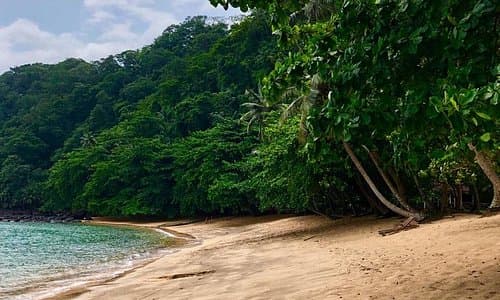
Pristine African island paradise with untouched rainforests and beaches
São Tomé sits 140 miles off the coast of Gabon, and most travelers have never heard of it. That's exactly what makes this volcanic island so special. You won't find resort chains or tour buses here — just empty beaches backed by rainforest, Portuguese colonial buildings slowly surrendering to tropical vines, and locals who still wave at strangers. The capital city shares the island's name and feels like a place where time moves differently. Roosters crow at dawn from backyards in the city center. Fishermen pull their boats onto black volcanic sand at Praia Lagarto. And somewhere in the jungle, endemic birds call from trees that have never seen a chainsaw. But here's the thing — São Tomé isn't trying to be anything other than itself. No Instagram-perfect beach clubs or manufactured experiences. Just an honest slice of equatorial Africa where cacao still grows wild and Portuguese creole mingles with African rhythms in the evening air.
Best Months
JAN · JUN · JUL · AUG · SEP · DEC
~27°C · moderate crowds
Culture & Context
CREOLE RHYTHM, COCOA LEGACY
São Tomé is a Portuguese-speaking, predominantly Catholic nation with a creole soul. The Forro people, descendants of freed slaves and among the island's oldest communities, carry a distinct cultural identity built over centuries of blended African and Portuguese influence. Forro Creole is spoken alongside Portuguese in daily life — formal settings use standard Portuguese, but informal conversation slides into Forro without warning.
Greet everyone before any transaction or question. "Bom dia" before noon, "boa tarde" in the afternoon. Skip the greeting and you register as rude, even if you didn't intend to.
The local philosophy of leve leve (easy, easy) governs the pace of everything. Plans shift. Taxis leave when full.
Restaurants run out of dishes. Factor in the rhythm before you push against it. Sunday mass at the Sé Cathedral draws the neighborhood in their finest clothes.
The cocoa and plantation history is central to the national identity — these islands were once the world's largest cocoa producer, and that legacy is everywhere, from crumbling roça buildings to the single-origin chocolate sold at Claudio Corallo's shop in the capital.
Local Customs
GREET FIRST, ALWAYS
Always greet before asking a question or making a purchase. 'Bom dia' (morning) or 'boa tarde' (afternoon) is non-negotiable social etiquette. Skipping it reads as dismissive..
Ask before photographing people. A simple 'pode tirar uma foto?' (can I take a photo?
) in rough Portuguese goes a long way. Don't point a camera without checking.. Tap water is not safe to drink anywhere on the islands.
Bottled water is available at supermarkets and corner stalls. Don't skip this.. Leve leve — the local philosophy of 'easy, easy' — means schedules are fluid.
Shared taxis leave when full. Restaurants run out of menu items. Build time buffers into plans..
Sunday mass at the Sé Cathedral in the capital is a genuine community event. Locals dress up. You can observe quietly from outside without intruding..
Bargaining is expected at local markets for souvenirs and produce. Be respectful about it — not aggressive.. Carry cash, preferably euros or $100 USD bills.
Smaller bills get worse exchange rates at banks, and many local spots don't take cards.. Malaria risk is moderate. Take prophylactics, use insect repellent, and sleep under treated nets — especially during the rainy season (October to May)..
Medical facilities are extremely limited. Serious conditions require evacuation, likely to Portugal or South Africa. Travel insurance with medical evacuation cover is not optional here.
Safety
SAFE STREETS, MEDICAL CAUTION
São Tomé is genuinely safe by regional and global standards. Around 85 out of 100 residents and visitors report feeling completely safe during the day, and 94 out of 100 feel secure at night. Violent crime against tourists is rare.
Evening walks through the capital's colonial streets are considered safe and atmospheric. That said, the bigger practical risks here are medical, not criminal. Medical facilities are severely limited — with only 0.
32 doctors per 1,000 inhabitants, even minor health issues can require evacuation at your own expense. Carry comprehensive travel insurance with medical evacuation coverage. Full stop.
Malaria risk is moderate year-round and higher during the rainy season (October to May). Take prescribed prophylactics, use DEET-based repellent, and sleep under treated nets. Tap water is unsafe island-wide — drink only bottled water.
The southern road loop washes out in heavy rain and some interior roads are impassable without a 4x4. ATMs run out of notes without warning — always keep a cash reserve. Dial 113 for police anywhere on the islands.
Getting Around
ALUGUERS & ISLAND FLIGHTS
Flights into São Tomé International Airport (TMS) connect through Lisbon and Accra — those are essentially your only options. Budget flights do not exist on these routes. Once on the island, aluguers (shared taxis) depart from São Tomé city's central market area on fixed routes to Trindade, Neves, and northern beaches.
They leave when full, not on schedule. Cheap and functional — expect a few dobras for local legs. For serious island exploration, rent a 4x4.
The road to Pico Cão Grande and the southern loop is rough and floods after rain. No exceptions on the vehicle requirement. Rental prices run approximately $80–120/day.
The domestic flight from São Tomé to Príncipe takes 35 minutes with STP Airways. One-way fares start around $50–80 booked early; prices spike sharply closer to departure, especially July–August. Book weeks in advance during Gravana season.
Inter-town shared minibuses (chapas) cost $5–15 per leg and are the budget option for longer island distances. Walking and cycling work well in the capital and near towns. The São Tomé and Príncipe dobra (STN) is pegged to the euro — a practical stability for travelers.
Bring euro cash. Only Visa cards work in local ATMs, and those ATMs run out of notes regularly.
Useful Phrases
Money-Saving Tips
- 1.Bring euros or US dollars — credit cards work only at upscale hotels and restaurants
- 2.Bargain at the Mercado Grande but pay asking price at small local shops
- 3.Shared taxis cost 5,000 dobras versus 50,000 for private rides
- 4.Local restaurants charge half what hotel restaurants do for the same fish
- 5.Buy chocolate directly from Claudio Corallo's factory shop for better prices than airport duty-free
Travel Tips
- •Pack reef-safe sunscreen — it's impossible to find on the island
- •Bring a good insect repellent with DEET for jungle excursions
- •Download offline maps before arriving — internet can be spotty outside the city
- •Learn basic Portuguese phrases — English isn't widely spoken
- •Carry small bills — many vendors can't make change for large denominations
- •Book accommodations in advance during dry season (June-September)