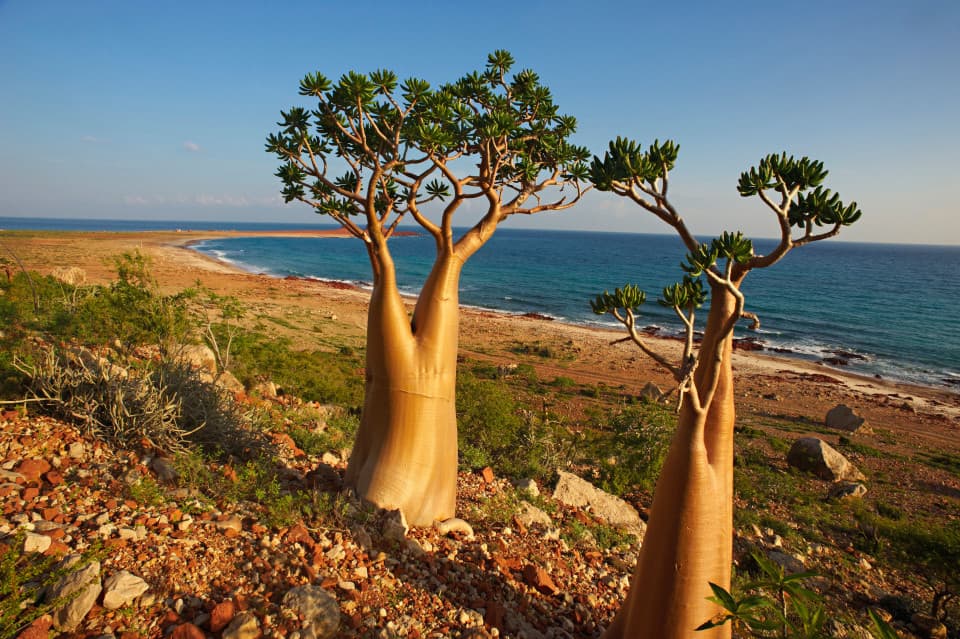
Socotra Island
Yemen's alien landscape of endemic wonders
Socotra Island looks like another planet. And honestly, that's not travel writer hyperbole – one-third of its plant species exist nowhere else on Earth. Dragon's Blood Trees dot the landscape like giant umbrellas. Bottle trees bulge from clifftops. The Arabian Sea crashes against white sand beaches that feel prehistoric.
This UNESCO World Heritage site sits 240 miles off Yemen's coast, isolated enough that evolution went rogue here. You'll spot Egyptian vultures soaring overhead and endemic sunbirds flitting between frankincense trees. The locals speak Soqotri, an unwritten language that sounds nothing like Arabic.
But here's the thing – Socotra isn't easy. Flights run sporadically. Hotels are basic. The roads test your patience. That's exactly why it remains one of the world's last untouched places. Come prepared for an adventure, not a vacation.
Culture & Context
ISOLATED ISLAND CULTURE
Socotra sits in the Arabian Sea about 240 km east of the Horn of Africa and 380 km south of mainland Yemen — closer to Somalia than to Sana'a, and it feels it. The island is technically Yemeni but currently administered with significant UAE backing. You'll see Emirati flags flying across the island.
The mainland's war never arrived here. Around 60,000 people live on Socotra, mostly along the north coast. The indigenous Socotri people are the descendants of a population that has been isolated long enough to evolve their own language and culture entirely separate from mainland Arab identity.
Most families still rely on fishing, goat herding, and date farming. Handicrafts — woven palm leaf goods, goat-wool textiles, clay figurines colored with dragon blood resin — are the main souvenirs worth buying. The island has no nightlife, no alcohol (it's a Muslim community), and very few restaurants outside Hadibo.
But none of that is the point. The point is that Socotra feels genuinely apart from the rest of the world, and the Socotri people reflect that — calm, curious, genuinely hospitable in a way that has nothing to do with tourism industry training.
Local Customs
TEA & MODESTY REQUIRED
Accept tea when it's offered. This is not optional etiquette — refusing is genuinely rude. Tea appears constantly, in villages, at campsites, after meals.
Drink it.. Use your right hand for greetings and passing food or objects. The left hand is considered unclean in Yemeni Islamic custom..
Do not photograph women without explicit permission — this is a firm boundary across the island and particularly strict in rural areas. Photographing men and children is usually fine and locals often enjoy it.. Cover shoulders and knees when walking through villages or towns like Hadibo and Qalansiyah.
At beach campsites, swimwear is acceptable. Once you move inland or into any settlement, cover back up.. There is no alcohol on the island.
It's a Muslim community and this is not a grey area. Some tour operators say you can technically bring your own, but this is disrespectful and best avoided.. Do not carve into or damage the dragon blood or bottle trees.
Some guides might offer to demonstrate the resin-bleeding trick — decline. The trees are already under ecological stress.. Bargaining at the Hadibo market is normal.
At handicraft stalls run by artisans, buying at a fair price without haggling aggressively actually contributes to preservation of traditional crafts.. The Socotri language is oral and nearly unwritten — if a local recites a poem, sings, or tells a story in Socotri, it is a rare and meaningful gesture. Treat it as such.
Safety
SAFE ISLAND, RISKY ACCESS
Here's the honest situation: most Western governments officially advise against all travel to Yemen, and that advisory includes Socotra. The island itself has stayed calm and conflict-free throughout the mainland war — travelers consistently report feeling safe there. But the advisory is real and worth understanding before you go.
The January 2026 airspace closure stranded around 600 tourists and is a useful reminder that regional politics can affect logistics with little warning, even if the island stays physically safe. On the ground, crime is virtually nonexistent. Walking around Hadibo at night is fine.
Your bigger risks are physical: medical facilities on the island are basic and poorly equipped, especially for serious injuries or illness. The two small hospitals can't handle emergencies well, and everything has to be imported. Carry a comprehensive personal first aid kit.
Get vaccinations for rabies (hospitals lack the post-exposure vaccine), and consult a travel clinic about cholera prophylaxis and malaria medication. Secure specialist travel insurance that explicitly covers high-risk zones — standard policies won't pay out. Drone use is restricted and in some cases prohibited near military areas and the airport.
Do not photograph anything that looks like military equipment or installations, and follow guide instructions at checkpoints without question.
Getting Around
CHARTERED FLIGHTS & 4X4
Getting to Socotra in 2026 means going through Jeddah. The Air Arabia Abu Dhabi charter flights are suspended following the early-January 2026 regional airspace closure. Yemenia Airways now operates the main route: one weekly flight between Jeddah and Socotra, costing around $900–950 round trip.
You cannot book this flight independently — it goes through your licensed tour operator. If you're not already near Jeddah, budget for connecting flights from your home country. A Cairo-Aden-Socotra Yemenia route also exists, but involves transiting mainland Yemen, which most operators and most governments advise against.
On the island, a Toyota Land Cruiser 4x4 is the only practical way to get around. Your tour operator provides a dedicated vehicle and driver. The main paved road follows the northern coast.
Anything heading inland — to Diksam Plateau, Homhil, or the southern dunes — involves rough dirt tracks that require proper 4x4 capability. Don't try to rent anything and drive yourself. Shared taxis run between Hadibo and nearby areas for around $5–10 a trip.
For Shoab Beach on the western coast, a boat from Qalansiyah is the practical approach — roads don't reach it reliably. Book at least 6 months ahead during the October–April peak season. Seats genuinely sell out.
Useful Phrases
Itineraries coming soon
We're working on adding amazing itineraries for Socotra Island. In the meantime, try the app to create your own!
Money-Saving Tips
- 1.Bring US dollars in cash - credit cards don't work anywhere on the island
- 2.Stock up on supplies in Hadibo before heading to remote areas - prices double outside town
- 3.Negotiate 4WD rental rates in advance - drivers quote higher prices to tourists initially
- 4.Buy bottled water in bulk from wholesalers near the port - saves 50% compared to hotel shops
- 5.Pack all medications and toiletries from home - the island has limited pharmacy supplies
- 6.Homestays cost half the price of guesthouses and include meals
- 7.Group tours split vehicle costs among multiple travelers - much cheaper than private hire
Travel Tips
- •Download offline maps before arrival - cell coverage is spotty outside Hadibo
- •Pack a good headlamp and extra batteries - power cuts are frequent
- •Bring reef-safe sunscreen - the sun is intense and shade is scarce
- •Learn basic Soqotri greetings - locals appreciate the effort since few tourists try
- •Pack lightweight long sleeves for evening protection against mosquitoes
- •Bring a portable phone charger - electricity isn't guaranteed in remote areas
- •Check flight schedules constantly - weather delays are common
- •Pack all prescription medications with extra supplies - no pharmacies outside Hadibo
Frequently Asked Questions
Explore Socotra Island
BUILD YOUR
SOCOTRA ISLAND PLAN
Insider picks, smart timing, and a plan ready when you are.
Start Planning