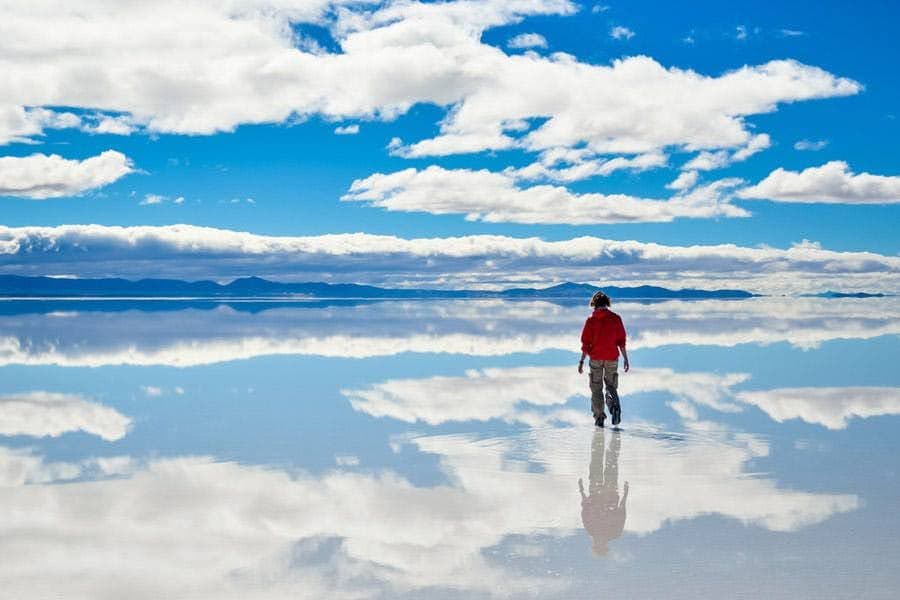
Uyuni Salt Flats
Bolivia's mirror of the sky in endless white wilderness
The Salar de Uyuni stretches 4,000 square miles of blindingly white salt crust across southwestern Bolivia. During dry season, it's an alien landscape of geometric salt formations and flamingo-dotted islands. Come rainy season, a thin layer of water transforms it into the world's largest mirror, reflecting clouds so perfectly you'll lose track of where earth ends and sky begins.
But here's what Instagram doesn't show you: the bone-chilling cold at 12,000 feet elevation, the complete lack of cell service, and the fact that most tours involve sleeping in salt hotels with paper-thin walls. The remoteness is real — you're four hours from the nearest proper town, surrounded by nothing but white as far as you can see.
Still worth it? Absolutely. Just pack more layers than you think you'll need.
Culture & Context
The name Uyuni literally means "soup bowl" in Aymara — fitting for a town sitting in a vast flat basin.
The Salar itself is deeply tied to Aymara and Quechua identity. Local legend holds that a love triangle between surrounding mountains Kusina, Kusku, and Tunupa formed the salt flats when the betrayed mountain goddess Tunupa wept until she filled the valley with her tears.
Communities living along the Salar's edges are the world's primary producers of royal quinoa and deeply respect the landscape — some even fear it. The Andean cosmovision (a spiritual worldview connecting humans to mountains, earth, and sky) shapes daily life here. Quechua and Aymara salt harvesting traditions are still practiced in Colchani village, visible in artisan workshops.
Bolivia has 37 official languages; in the Uyuni region, Andean Spanish blends heavily with Aymara and Quechua vocabulary. Local speech is slower and clearer than elsewhere in South America — great for Spanish learners. Diminutives are used constantly and affectionately: strangers become "amiguito," tables become "mesitas.
" When someone says "Tal vez" (maybe) or "Ahorita" (right now), it often means later or much later — patience is essential. Bolivians are formal and polite; use "Usted" rather than "Tú" with older people or strangers. Coca leaves hold sacred cultural significance for altitude and spiritual practice — chewing them gently or as tea is normal and expected at elevation.
Local Customs
Chew or brew coca leaves for altitude sickness — it's culturally normal and locally recommended.
Buy a small bag at any market in Uyuni for a few Bolivianos.. Always ask permission before photographing local people.
A smile and 'puedo sacar una foto?' goes a long way. Many locals in Colchani and small villages decline, and that's respected..
Remove your shoes when entering salt hotels — the floors are made of salt blocks and footwear damages the surface.. Bargain politely at markets but never haggle at restaurants. Trying to negotiate a meal price is considered rude..
Bring only Bolivianos or US dollars in cash. ATMs in Uyuni run dry during peak season (June–August and December–February). There are zero ATMs on the salt flats or in tour refuges..
Don't accept torn Boliviano notes as change — they can be refused elsewhere, even though technically still legal.. Tip your tour driver/guide 10–15% — they work grueling hours in extreme conditions and tips are a significant part of their income.. Political protests and roadblocks are common throughout Bolivia.
If you encounter one, stay calm, do not try to cross, and monitor local updates. They typically resolve within hours.. Carry a photocopy of your passport while exploring town and keep the original secured at your hotel..
Tour operators in Uyuni town have a reputation for scams and inflated prices. Book reputable operators in advance online or from La Paz rather than off the street in Uyuni.
Safety
The Uyuni region is one of the safest areas in Bolivia for tourists, with violent crime being extremely rare.
The real risks here are environmental and logistical, not criminal. Altitude sickness is the number-one danger: the Salar sits at 3,656 meters, and multi-day tours climb above 4,800 meters at the Sol de Mañana geysers.
Spend 2–3 days acclimatizing in La Paz or Cusco before you arrive. Drink water constantly, skip alcohol your first nights, and buy coca leaves at any Uyuni market for a few BOB — chew or brew as tea. UV radiation at this altitude is brutal.
The white salt surface reflects sunlight from below AND above simultaneously. You can burn in under 15 minutes and risk genuine snow blindness if you skip sunglasses. Bring polarized UV-protective glasses, SPF 50+ sunscreen, and a wide-brimmed hat.
Night temperatures regularly drop to -10°C to -15°C even in warmer months. A base layer, fleece, windproof outer shell, gloves, and a warm hat are non-negotiable. During the rainy season (December–April), the salt crust can be thin in places and you can sink into mud beneath.
Always stay with your guide on marked routes. Independent salt flat exploration is not recommended — there are no roads, markers, or landmarks, and rescue services do not exist. Nearest medical care is a 3–4 hour drive away.
Travel insurance with medical evacuation coverage is essential. For petty theft in town: carry photocopies of your passport, keep bags close in the market and bus terminal, and avoid empty streets after 10 PM. Use marked 'radio taxis' in town rather than unmarked vehicles.
Roadblocks from protests are common in Bolivia and can disrupt travel plans — monitor local updates and build flexibility into your itinerary. Complete the free SIGEMIG online pre-registration before arriving in Bolivia to avoid delays at immigration.
Getting Around
Getting to Uyuni: Fly into Uyuni Joya Andina Airport (UYU) — about 50 minutes from La Paz on BoA (Boliviana de Aviación) or EcoJet, roundtrip fares run $87–174 USD.
Taxis from the airport to Uyuni center cost 20 BOB ($3) for the 10-minute ride; no public buses serve the airport. Alternatively, take an overnight bus from La Paz (12 hours, 120–200 BOB / $17–29 USD) — use Todo Turismo or El Dorado for safety and comfort.
They use proper bed buses and have solid safety records; avoid other companies. The Expreso del Sur train from Oruro runs overnight and takes about 7 hours with scenic altiplano views ($15 first class). Getting to the Salt Flats: Tours exclusively use 4x4 Land Cruisers (typically 6 passengers plus driver per vehicle).
All tour pickups are from your accommodation in Uyuni center. There is absolutely no public transport across the Salar. Crossing to Chile: 3-day tours departing from San Pedro de Atacama ($180–350 USD) cross the Hito Cajón border adding 1–2 hours; bring your passport.
The reverse (Uyuni to San Pedro) follows the same route in reverse. Tours depart Uyuni at 7:00–7:30 AM, arriving San Pedro on day three around 1–2 PM. Booking tip: Book reputable operators in advance online or from La Paz — avoid booking off the street in Uyuni where scams and inflated prices for low-quality tours are common.
Recommended operators include Banjo Tours and Ruta Verde for higher quality; Condor Trekkers and Salt Flat Biking Uyuni for active/adventure focus.
Useful Phrases
Money-Saving Tips
- 1.Bring US dollars in small bills - many tour operators don't accept credit cards and ATMs in Uyuni often run out of cash
- 2.Book tours directly in Uyuni town to save 20-30% compared to booking online from La Paz
- 3.Pack your own snacks and water - prices on tours can be 3x normal rates
- 4.Stay in Uyuni town instead of salt hotels to cut accommodation costs in half
- 5.Take the overnight bus from La Paz instead of flying to save $100+ per person
Travel Tips
- •Pack serious cold weather gear - temperatures drop to 5°F at night even in summer
- •Bring sunglasses and SPF 50+ sunscreen - the salt reflects UV rays intensely
- •Download offline maps before leaving Uyuni town - cell service disappears completely on the flats
- •Take altitude sickness medication and arrive a day early to acclimatize at 12,000 feet
- •Bring toilet paper and hand sanitizer - facilities are extremely basic on multi-day tours
Frequently Asked Questions
BUILD YOUR
UYUNI SALT FLATS PLAN
Insider picks, smart timing, and a plan ready when you are.
Start Planning