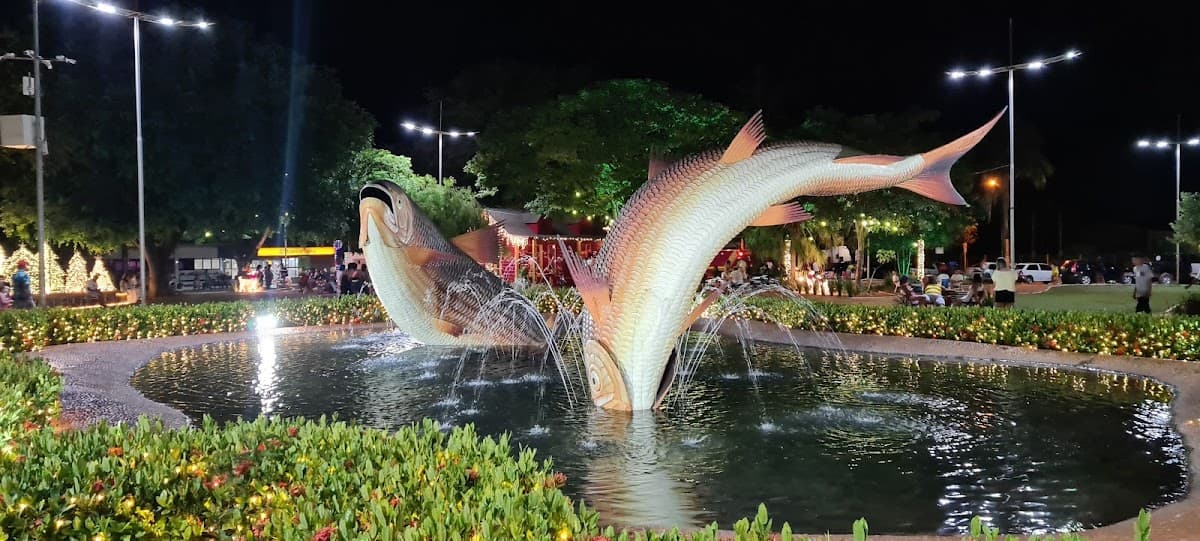
Bonito
Brazil's crystal-clear river paradise for eco-adventure seekers
Look, Bonito isn't your typical Brazilian beach town. This small city in Mato Grosso do Sul has something way better than ocean waves — rivers so clear you can see 40 meters to the bottom. The limestone geology here creates natural aquariums where you'll swim alongside schools of piraputanga fish and spot giant otters lounging on riverbanks. It's like someone built a theme park, except Mother Nature did all the work.
Best Months
APR – SEP
~28°C · moderate crowds
Culture & Context
CARBON-NEUTRAL ECOTOURISM LEADER
Bonito means "beautiful" in Portuguese, and locals will tell you that with a straight face and zero irony. It actually earns the name. This is a former cattle ranching region in Mato Grosso do Sul that quietly reinvented itself as Brazil's ecotourism capital starting in the 1970s and '80s.
Today, it holds the distinction of being the world's first carbon-neutral ecotourism destination, certified in 2022 by Green Initiatives. That's not just a marketing badge. The whole town runs on a model where daily visitor caps, mandatory guides, and fixed tour prices are enforced by the municipality.
You cannot just show up at the Gruta do Lago Azul and wander in. Everything is scheduled, everything is guided, and the prices — every single one of them — are set by local ordinance. Brazilians call it "tabelado.
" Shopping around for a cheaper deal is pointless; all agencies on Rua Coronel Pilad Rebuá charge exactly the same. What differs is their service. Bonito has been elected Brazil's best ecotourism destination more than 16 times, and the infrastructure reflects that.
It's also a place where the Cerrado (Brazil's vast, dry savanna biome) meets the fringes of the Pantanal, meaning wildlife density here is genuinely surprising. And in May 2026, LATAM launched a direct route from Guarulhos (São Paulo) to Bonito Airport (BYO), which is a big deal for accessibility.
Local Customs
PRICES FIXED, GUIDES MANDATORY
All tour prices in Bonito are fixed by the municipality — a system called 'tabelado.' Do not waste time trying to negotiate at agencies. The experience and service quality are what differentiate them, not the price..
You cannot wear sunscreen, sunblock, or bug spray in the water during river floating tours. The ecosystem is protected and these chemicals are banned in the water. Use them before you gear up, let them absorb, and that's it..
Guides are mandatory on every single attraction. This isn't bureaucratic padding — guides here are genuinely trained environmental educators, and their commentary adds real depth to what you're seeing.. Book everything before you arrive.
Seriously. Slots at the major attractions (Rio da Prata, Gruta do Lago Azul, Abismo Anhumas) fill up fast, especially in July, August, December-January, and during Easter.. PIX — Brazil's instant bank transfer system — is used everywhere and often earns you small discounts.
Having a Brazilian bank account or getting help from your pousada to use PIX will save you a bit.. The standard greeting among friends is a kiss on the cheek (right to left). Between men who know each other, it's a hug plus handshake.
Thumbs up is universally understood as 'great.' The OK sign (thumb and forefinger circle) can be considered rude — skip it.. Tours can be cancelled or rescheduled on the day if there are storms or lightning risk.
This is non-negotiable for safety. Caves like Gruta São Miguel and Abismo Anhumas tend to stay open on rainy days — floating rivers do not.
Safety
VERY SAFE, NATURE RISKS
Bonito is one of the safest places to visit in Brazil, full stop. It's a small organized ecotourism town of around 22,000 people where the entire economy runs on making visitors feel welcome and safe. Petty crime that plagues larger Brazilian cities is not a meaningful concern here.
The real risks are nature-related: tours can be cancelled without notice if there's a lightning storm (guides are serious about this), some trails require moderate fitness, and the water in caves and rivers is cold even in summer. Always wear closed shoes on any trail — guides will tell you, but just internalize it now. Sunscreen and chemical products are banned in the water at all floating tours; respect this.
It protects the ecosystem and it's enforced. For broader Brazil context: the U.S.
State Department rates Brazil at Level 2 (Exercise Increased Caution), but that advisory reflects urban crime in cities like Rio and São Paulo — not small ecotourism towns like Bonito. Emergency number in Brazil is 190 (police) or 192 (medical). A yellow fever vaccination is strongly recommended before visiting Mato Grosso do Sul.
Getting Around
RENT CAR OR TOUR VAN
Getting to Bonito takes a bit of commitment, but that's part of the deal. The easiest new option (as of May 2026) is LATAM's direct flight from São Paulo Guarulhos to Bonito Airport (BYO). Before that, the standard route was flying into Campo Grande (CGR) and then driving about 260-300km, a trip of roughly 3.
5 hours. The road is well-maintained, clearly signposted, and toll-free. Renting a car in Campo Grande makes the most sense if you want flexibility.
Buses from Campo Grande to Bonito do exist and are budget-friendly, though the schedule is less frequent. Once in Bonito, forget Uber. It doesn't really operate here.
All the natural attractions are spread across rural properties, several kilometers from town, on dirt roads. You either book transport through your tour agency (they usually provide vans for pick-up and drop-off) or rent a car to get yourself there. The dirt roads are actually fine for economy cars.
Tour timing is strict — if your agency says 7:30am, they mean 7:30am.
Useful Phrases
Money-Saving Tips
- 1.Book tours directly with operators instead of through your pousada to save 20-30% on commissions
- 2.Bring cash — many tour operators and restaurants don't accept cards, and ATMs charge hefty fees
- 3.Pack your own snorkeling gear to avoid R$25 daily rental fees at each attraction
- 4.Stay Sunday through Thursday to get better pousada rates and avoid weekend crowds
- 5.Buy groceries at Atacadão supermarket to save on breakfast and snacks — restaurants add up quickly
Travel Tips
- •Book popular tours like Rio da Prata 2-3 weeks ahead during peak season (July-August)
- •Bring reef-safe sunscreen — regular sunscreen damages the delicate river ecosystems
- •Pack quick-dry clothes and water shoes for multiple river activities per day
- •Download offline maps before heading to remote attractions — cell service cuts out frequently
- •Start tours early (7-8am) to beat crowds and afternoon heat, especially at underwater caves