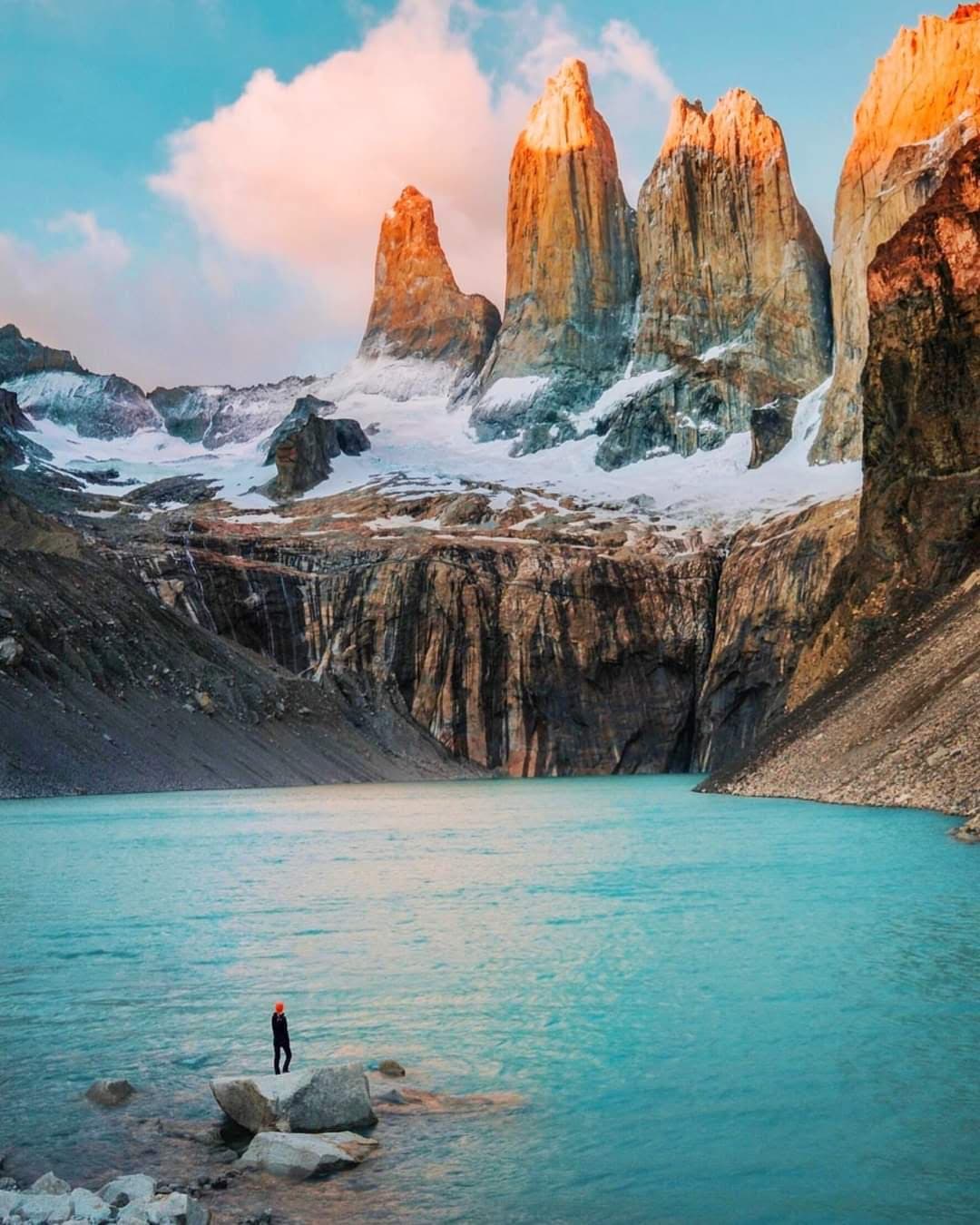
Torres del Paine National Park
Patagonia's granite towers rising from pristine wilderness
Three granite spires pierce the Patagonian sky like ancient monuments to wilderness. Torres del Paine isn't just another national park—it's where hikers come to test themselves against some of South America's most dramatic terrain. The park sprawls across 935 square miles of Chilean Patagonia, where turquoise lakes reflect jagged peaks and guanacos graze beneath towering granite walls.
But this isn't a casual weekend getaway. The weather here changes faster than you can zip up your rain jacket, and the famous W Trek will push your legs to their limit. Still, there's something magnetic about this place that draws adventurers from around the world. Maybe it's the way morning light sets the Torres ablaze in gold and pink. Or how the silence here feels deeper than anywhere else on earth.
The park sits in the transition zone between the Andes and the Patagonian steppe, creating landscapes that shift from emerald forests to windswept grasslands within a single day's hike. Condors ride thermals above glacial valleys, while foxes dart between lenga trees. This is Patagonia at its most raw and beautiful.
Culture & Context
PATAGONIAN IDENTITY RUNS DEEP
Torres del Paine sits in Chilean Patagonia's Magallanes region, a remote frontier zone shaped by 19th-century European settlers (mainly from Croatia, Germany, and Britain), indigenous Tehuelche heritage, and the ranching culture of estancias and gauchos. Sheep farming still defines the landscape beyond the park boundaries, and cordero asado (spit-roasted lamb) is the region's signature dish. The population is sparse and resilient — locals are matter-of-fact about extreme weather and genuinely proud of their land.
Puerto Natales, the gateway town of ~20,000 people, has shifted from fishing port to trekker hub over the past two decades but retains a rough-edged charm. Expect colorful corrugated-metal houses, late-night bars full of international hikers, and locals who will tell you with complete sincerity that you can experience all four seasons in a single day — because you can. Conservation is a serious local concern; the 2011 wildfire that burned 17,000 hectares after a tourist's careless act is still part of every conversation about park ethics.
Local Customs
LEAVE NO TRACE ABSOLUTE
No campfires anywhere in the park — ever. Only camp stoves in designated areas. This is non-negotiable and stems from the devastating 2011 wildfire.
Rangers will expel violators.. No drones. Flying one inside park boundaries gets you ejected and reported to Chilean civil aviation authorities..
No swimming in any water body. Glacial temperatures cause hypothermia almost instantly.. Move quietly on the trails.
Playing music through speakers is considered disrespectful — use headphones.. Stay on marked trails. Off-trail hiking is prohibited to protect fragile vegetation..
Pack out all your trash. Bins exist at campsites but are limited; carry a bag for trail waste.. Tipping is appreciated but not mandatory.
In restaurants, 10% is the norm. At guided tours and lodges, $100 USD per stay split among staff is a common suggestion.. Chileans are generally reserved at first but warm quickly.
A greeting goes a long way — always say 'buenos días' or 'buenas tardes' when entering a shop or passing a ranger.. Don't expect to find ATMs in the park. Withdraw enough Chilean pesos (CLP) in Puerto Natales before you enter..
Respect wildlife distances. Don't approach guanacos, foxes, or pumas (however exciting). Puma sightings are increasingly common near the park's eastern sector..
Pre-book everything. Park entrance tickets, refugio beds, and camping spots must be reserved in advance online. Walk-ups are not an option for multi-day treks.
Safety
WIND & WEATHER DOMINATE
Torres del Paine is physically demanding and weather-driven — take the risks seriously. Wind is the main danger: gusts regularly exceed 100 km/h (62 mph) and can physically knock you down or fling rocks. There have been bus-flip incidents.
Always check forecasts before heading out on long hikes. The park can experience all four seasons in a single day — rain, sun, hail, and snow are all possible within a few hours. Dress in waterproof layers regardless of the morning forecast.
No swimming is allowed anywhere in the park; glacial water causes hypothermia almost instantly. There is no cell signal across most of the park. In emergencies, contact a ranger or a guide with radio equipment.
Park administrative HQ: +56 61 2360496. Carabineros de Chile: +56 61 2761139 (satellite phone only inside park). The nearest hospital is in Puerto Natales (1.
5 hours from park center); serious cases go to Clínica Magallanes in Punta Arenas (5 hours). All guides from established operators carry WFR (Wilderness First Response) certification. There are no puma attacks on humans on record in the park, but maintain respectful distances.
No fuel inside the park — fill up in Puerto Natales or Esperanza. Carry offline maps (Maps.me) as GPS signal can drop.
Sunburn at this latitude is a real risk even on overcast days — SPF 30+ is essential. Chile is generally very safe for travelers; petty theft is the main concern in urban areas, not in the park.
Getting Around
BUS & CATAMARAN DEPENDENT
Getting here requires two flights for most international visitors: Santiago (SCL) is the main international hub, then either Punta Arenas (PUQ) — up to 6 flights daily in high season — or Puerto Natales (PNT), which has just 1 seasonal daily flight and fills fast. From Punta Arenas, take a 3-hour bus to Puerto Natales (Buses Pacheco or Fernández direct from airport). From Puerto Natales, the park is 80–130km away (1–2 hours depending on sector).
Bus options: Multiple companies (Bus-Sur, Buses Pacheco, Buses Fernández, Buses María José, Cootra) depart from Terminal Rodoviario on Av. España 1455 daily during high season. Morning departures around 7:00–8:00 AM.
Cost: $10–16 USD one-way. The bus makes five stops: Laguna Amarga (eastern W Trek start and CONAF check-in), Pudeto (catamaran dock for Paine Grande), Camping Pehoé, Administración, and Hotel Lago Grey. Laguna Amarga is mandatory for CONAF documentation.
Car rental: Available in Punta Arenas (best selection and prices) or Puerto Natales. Roads inside the park are gravel with a 40 km/h speed limit. No fuel available inside the park — fill up in Puerto Natales.
If crossing to/from Argentina (El Calafate): bus via Paso Río Don Guillermo, ~5–7 hours. Confirm your rental car is authorized for border crossings. Within the park: The only internal shuttle runs between Torres Central/Norte Welcome Center and Laguna Amarga (several times daily, matches bus schedules).
The Lago Pehoé catamaran connects Pudeto with Paine Grande — a key W Trek link. Coming from El Calafate: Bus Sur and Turismo Zaahj both run the route at ~$30 USD.
Useful Phrases
Itineraries coming soon
We're working on adding amazing itineraries for Torres del Paine National Park. In the meantime, try the app to create your own!
Money-Saving Tips
- 1.Book refugios and campsites 6+ months ahead to avoid premium last-minute prices
- 2.Pack your own food for multi-day treks - refugio meals cost $25-35 each
- 3.Stay in Puerto Natales instead of El Calafate to save on accommodation costs
- 4.Visit in shoulder seasons (November or March) for 30-40% lower prices on hotels
- 5.Rent gear in Puerto Natales rather than buying - sleeping bags cost $15/day vs $200+ to purchase
- 6.Take the bus from El Calafate instead of private transfers - saves $100+ per person
- 7.Bring a water filter instead of buying bottled water throughout your trek
Travel Tips
- •Start the Base Torres hike at 4am to catch sunrise on the granite towers
- •Pack extra batteries for your headlamp - Patagonian nights are long and cold
- •Download offline maps before entering the park - cell service is spotty at best
- •Bring duct tape for emergency gear repairs in harsh Patagonian conditions
- •Layer clothing systems instead of bulky jackets - weather changes every hour
- •Book your return bus tickets when you arrive - they sell out during peak season
- •Carry cash in Chilean pesos - many park services don't accept cards
- •Register your trekking plans with rangers, especially for the remote O Circuit sections
Frequently Asked Questions
Explore Torres del Paine National Park
BUILD YOUR
TORRES DEL PAINE NATIONAL PARK PLAN
Insider picks, smart timing, and a plan ready when you are.
Start Planning