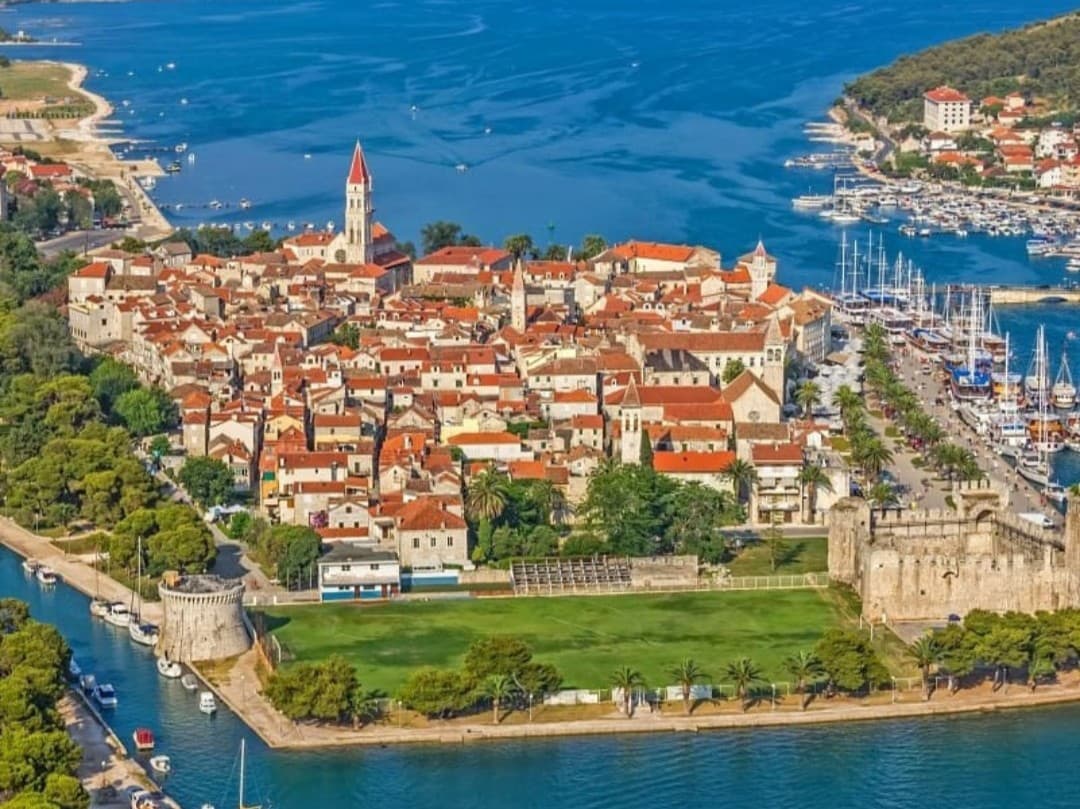
Trogir
Venetian stone poetry on Croatia's Dalmatian coast
Trogir sits on its own small island, connected to the mainland by bridges, like a medieval movie set that forgot to pack up after filming. This UNESCO World Heritage site crams more Romanesque and Gothic architecture into 10 hectares than most countries manage in entire regions. The old town's marble streets have been polished smooth by centuries of footsteps, and every corner reveals another carved portal or stone loggia that makes you stop mid-conversation.
But here's what makes Trogir special: it's not a museum. Locals still live within these ancient walls, hanging laundry from Gothic windows and running family restaurants in 13th-century cellars. The town balances its historic gravitas with a relaxed coastal vibe – you can spend the morning exploring Kamerlengo Fortress and the afternoon swimming at nearby beaches on Čiovo Island. And unlike Dubrovnik's crowds, Trogir still feels manageable, especially if you visit outside peak summer months.
Best Months
MAY – SEP
~28°C · high crowds
Culture & Context
VENETIAN MEDIEVAL MASTERPIECE
Trogir is a medieval island-city, roughly a square kilometer of stone streets wedged between the Croatian mainland and Čiovo Island. It's been continuously inhabited since the Greeks arrived in the 3rd century BC. The Venetians then ran the place for nearly 400 years from the early 1400s, and they left their mark everywhere.
Look at the carved doorways, the winged Lion of St. Mark worked into facades, the elegant loggia on the main square. UNESCO gave it World Heritage status in 1997, and that status is well-earned.
The Cathedral of St. Lawrence alone, built between the 13th and 17th centuries, is one of the finest pieces of Romanesque-Gothic architecture you'll find anywhere in central Europe. Master Radovan carved its north portal in 1240.
The detail is extraordinary. But Trogir isn't a museum town. Locals still live inside the walls.
Kids kick balls in the squares at dusk. The fishing boats still go out from Čiovo. That combination of lived-in texture and serious historical weight is what makes it genuinely worth your time, not just a box to tick between Split and Dubrovnik.
Local Customs
COVER UP, EMBRACE POMALO
Dress code matters. Swimwear and bare chests are not acceptable once you're off the beach and inside town. Croatian coastal towns including nearby Split have laws against wandering around in swimwear.
Cover up before walking into the old town.. In churches, shoulders must be covered and hats come off. The Cathedral of St.
Lawrence is still an active place of worship.. Tipping is not mandatory but is appreciated. Rounding up the bill or leaving 10% at a sit-down restaurant is standard and welcome..
Embrace pomalo. It's the Dalmatian philosophy of taking things slowly. Don't expect Italian-speed service in a restaurant.
That's not rudeness, it's the pace of life here. Go with it.. Dalmatians, particularly in the morning, are not big talkers before their coffee.
Don't be put off by a quieter, more reserved greeting at breakfast. It's cultural, not hostile.. Always ask for the bill (račun) directly — it won't come automatically.
Waiters consider it rude to rush you out.. Public drinking is restricted in Croatia's historic centers. Split has formalized fines for it.
Trogir is similar. Stick to bar and restaurant terraces.. Tap water is safe and drinkable throughout Croatia.
Skip the plastic bottles.
Safety
VERY SAFE, COMMON SENSE
Croatia holds a Level 1 travel advisory (exercise normal precautions) from the US, Australian, and Canadian governments as of 2026. In 2025, Croatia was ranked the safest country in the EU for walking at night, according to a Eurostat-backed survey. Trogir itself is a low-crime town.
Here's the thing: the main risks are ordinary tourist stuff. Pickpocketing exists in crowded areas (the main square, the Riva during high season) but nowhere near the scale you'd see in Barcelona or Rome. Keep your bag zipped, don't flash expensive gear, and you'll be fine.
Watch out for inflated tourist pricing at waterfront restaurants, particularly on the Riva — always check a menu before sitting down, and remember you're legally entitled to a receipt. Skip the Euronet ATMs scattered around and use a proper bank ATM instead. Taxi overcharging is occasional; use Bolt or agree on a fare before getting in.
Beach safety: sea urchins lurk in rocky shallows so water shoes are worth packing. Emergency number is 112 for everything.
Getting Around
WALKABLE, PARKING HEADACHE
Trogir sits about 30 km west of Split and is literally 5-10 minutes from Split Airport. That makes it one of the most convenient arrivals in Croatia. If you're flying into SPU, you can be at your accommodation before the taxi from Split Airport would even reach central Split.
Buses from Split run regularly and take 30-45 minutes depending on traffic. From May to September, a seasonal boat service runs between Split's Riva and Trogir — slower than the bus, but the views make it worthwhile at least once. The old town itself is fully pedestrianized.
No cars, no bikes, just stone lanes and your feet. Parking is the real headache. In summer, finding a spot near the old town is nearly impossible.
Use the large paid parking lot just north of the main bridge (GPS it in advance) and walk in — it's only a few minutes. Since 2018, a second longer bridge connects Čiovo Island back toward Split, which reduces through-traffic in the old town significantly. Local buses also run between Trogir and villages on Čiovo.
Regular bus connections link Trogir to Split (30 min), Zadar (2.5 hrs), Dubrovnik (5.5 hrs), and Zagreb (6.
5 hrs) from the bus station just north of the main bridge.
Useful Phrases
Money-Saving Tips
- 1.Visit in May or September for 30-40% lower accommodation prices compared to July-August peak season
- 2.Eat lunch at local konobas away from the main square – prices drop significantly just one street back
- 3.Buy groceries at Konzum supermarket on the mainland side to save on breakfast and snacks
- 4.Take the public bus to Split (€3) instead of tourist shuttles that charge €15-20 per person
- 5.Book accommodation directly with small hotels or apartments to avoid booking site commissions
- 6.Pack reef shoes for rocky beaches on Čiovo Island instead of renting them for €5 per day
Travel Tips
- •Bring comfortable walking shoes with good grip – the marble streets get slippery when wet
- •Download offline maps before exploring – GPS can be spotty within the thick stone walls
- •Pack a light jacket even in summer – evening breezes off the Adriatic can be cool
- •Learn a few Croatian phrases – locals appreciate the effort, especially older generations
- •Carry cash – many smaller restaurants and shops don't accept cards
- •Visit the Cathedral of St. Lawrence early morning or late afternoon to avoid cruise ship groups
- •Bring a reusable water bottle – public fountains are safe and help reduce plastic waste